Showing posts with label Nakamura. Show all posts

Tuesday, June 14, 2011

Self-Erasure and Existence in Serial Experiments Lain and Metropolis

The two films that I shall be exploring in this paper are Ryutaro Nakamura's Serial Experiments Lain and Rintaro's Metropolis. Lain follows the story of a young girl named Lain who is in junior high and starts experiencing increasingly strange events. She meets "alter egos" of herself, and as she becomes more and more enmeshed in the world of the Wired, which is an imitation of the Internet, she starts questioning her own identity and existence. As people start dying around her, she attempts to find out who is behind these events, while at the same time the boundaries between reality and the Wired are falling apart. In her search, she meets the 'God' of the Wired, who, as it is later revealed, tries to convince people to give up their physical bodies and so transcend their earthly lives to exist in the Wired. After Lain destroys the God in a final confrontation, she is able to reverse the strange events that have been happening since the start of the series in a sort of "All Reset." By erasing memories of herself from everyone else's memories, she ceases to exist to them and to herself.

Metropolis
on the other hand is set in the future, where robots are constantly present as servants, or more precisely slaves, of humans, and are kept strictly in their place. Tima, created as a super-robot for the purpose of sitting upon the throne of the Ziggurat,[1] meets Kenichi, the nephew of the detective from Japan who was sent to capture the mad scientist that had created Tima. Rock, Duke Red's[2] sort-of-adoptive son and leader of the Malduks,[3] attempts to kill Tima out of both jealousy for his semi-affectionate regard for her[4] and prejudice against robots.[5] Nonetheless, Tima is able to escape his attempts with the help of Kenichi, though Tima eventually ends up in the Duke's grasp. In the final scenes, Tima loses her memories as her "robotic side" takes over, and seemingly fulfills her purpose by sitting upon the Ziggurat. However, she proclaims an apocalypse to punish the humans for their mistreatment of the robots. Kenichi is able to pull her from the throne and save her from completely merging with the throne. Seeming to have lost her memories, Tima attacks Kenichi. As the city crumbles around them, Tima regains her memories towards the end of the anime and unfortunately falls to her death from the great height of the Ziggurat to the ground below. Metropolis ends with Kenichi deciding to stay in Metropolis rather than go home with his uncle in the hopes of helping to rebuild Metropolis and create a better future, where presumably humans and robots can coexist.

Serial Experiments Lain and Metropolis are both very different, in subject matter as well as style. However, I feel that the importance of memory with identity and self present in both works are of interest, and I would like to explore the characters of Tima and Lain in particular. I intend to explore the concept of self or subjectivity and what that means when that self is erased in the figures of Tima and Lain. I claim that, despite their self-erasure, there exists identity within that erasure, rather than a lack of a self. Their self-erasure results in questions of identity and existence for these characters, and I shall attempt to prove that a new self is created, allowing for existence within erasure. Defining subjectivity in Lain and Tima however is problematic, given that one is possibly a computer program and the other a robot, therefore I believe that it is necessary to first define the self that is being erased.

In Lain, the series leaves the question of whether Lain is a computer program or not unanswered. One theory, according to The God of the Wired, is that Lain is a computer program, designed to break down the barriers between reality and the Wired, and that her physical body is one that he has given her. This theory would allow us to reconcile her apparent agelessness in the last episode.[6] The other theory would be that she has given up her body to "live on" in the Wired. Although this question cannot be definitely resolved, nonetheless in either case Lain has a self, the real-world self, one that exists or existed in what the anime presents as the real world. At this point I would like to mention that there are three Lains, her "alter egos", that make up Lain but cause problems in defining who Lain really is. This is a question that Lain, the real-world Lain, struggles with, as she is unable to connect who she thinks she is and what she knows and experiences as her existence, with the actions and character of Wired Lain that she only hears about through a second-hand source.


(Figure 1)

This image, taken from the artbook for Lain, is an attempt by the artists to differentiate between the three Lains. Their names are written differently[7] and as the image shows, there are certain expressions, postures, as well as speech characteristics unique to each Lain.

While these Lains present another problem in defining Lain's selfhood, the point is moot when in the end all of Lain is erased. However, although the different Lains are distinct, there is a merging of the Lains, at least of Wired & real-world Lain, that is shown by contrasting the behavior of Lain in episode two, "Girls", and episode seven, "Society". In "Girls", she has just received her Navi, which is basically a computer, but she is still shy and withdrawn, "unconnected".[8] Some of her classmates take her along to a club called Cyberia, but she does not know how to dress for the occasion and has clearly not been to a club before, a fact that a couple of them tease her about: "You're usually in bed now, aren't you, Lain?" says one, followed by, "Lain, don't you have anything better to wear at night?" This is also the first instance in which we hear about Wired Lain. As the anime progresses, real-world Lain seems to be incorporating Wired Lain, showing a merging as she becomes more confident and dresses a little differently. This merging culminates in "Society" in which there is a scene where Wired Lain sort of "takes over" real-world Lain's body.[9] The immediate contrast between real-world Lain and Wired Lain is shown clearly, as well as the struggle with identity that Lain faces.

During the series she increasingly questions who she is, and tries to reconcile her own memories, experiences, and who she thinks she is with her alter-egos. The climax of this struggle is shown in episode eight, "Rumors", in which all three Lains make an appearance following a certain rumor about Alice that Lain apparently spread on the Wired.[10] In these scenes, real-world Lain is shown buried under wires and cables, crying and helpless, while Wired Lain confronts Lain of the Rumor. "Who are you? You're not me. I'd never do what you do," Wired Lain says to her, as Rumor Lain laughs continuously. "Stop it! Why are you acting like the part of me that I hate? You--" With Wired Lain's hands wrapped around her throat, Rumor Lain laughingly cuts her off saying, "I'm committing suicide!" and continues, greatly amused, "Hey, I'm Lain, aren't I?" Both Wired and real-world Lain emphatically deny this, however that is not to say Rumor Lain is not a part of Lain.

This struggle in identity is resolved in a way in the end, though rather bittersweetly when Lain must erase memories of herself, and therefore her existence, from other's memories. "When you don't remember something, it never happened... If you aren't remembered, you never existed,"[11] says Alice, repeating Lain's words. Without the recognition of others, Lain ceases to exist in the real world. The disconnect in identities that Lain experiences is addressed by Scott Bukatman in Terminal Identity: the virtual subject in postmodern identity, in which he says,

The newly proliferating electronic technologies of the Information Age are invisible, circulating outside of the human experiences of space and time. That invisibility makes them less susceptible to representation and thus comprehension at the same time as the technological contours of existence become more difficult to ignore...There has arisen a cultural crisis of visibility and control over a new electronically defined reality. It has become increasingly difficult to separate the human from the technological...as electronic technology seems to rise, unbidden, to pose a set of crucial ontological questions regarding the status and power of the human...the Information Age, an era in which, as Jean Baudrillard observed, the subject has become a "terminal of multiple networks." This new subjectivity is at the center of Terminal Identity. (Bukatman 2)

Bukatman argues against the idea that cyberspace is a null space, and instead is a narrative space, a site of action and circulation that sets up for a new identity. This new identity is termed "Terminal identity: an unmistakably doubled articulation in which we find both the end of the subject and a new subjectivity constructed at the computer station or television screen" (9). It is this terminal identity that is created in Lain's self-erasure. I also argue that it is this terminal identity that is created, and exists, within the Wired that is more wholly Lain, and where she is able to resolve her struggle in identity, or at the very least comes to terms with her self-erasure and ceasing to exist. In the real world, the life that Lain leads is monotonous, and the world that she lives in is routine and life-less. As Susan Napier notes, "Increasingly in Japanese culture, the real has become something to be played with, questioned, and ultimately mistrusted" (421). She goes on to analyze Lain in its ability to portray the "fundamental concerns at the turn of the twenty-first century, most notably our sense of a disconnect between body and subjectivity thanks to the omnipresent power of electronic media" (Napier 431), and calls Lain a representation of the world of the Wired/Internet where reality and truth are constantly questioned (431).


(Figure 2: The same series of montages (like the one shown above) are shown in the beginning of every episode.)


(Figure 3: The above images are, left to right, from episode 1 and episode 2.)

Repetitive scenes and montages like the above screenshots signal Lain's life as lacking in some way. She is not completely free to be who she is as her different personas are segregated and it is not until the end with her self-erasure that she exists wholly in the Wired. In a way then, the cyber world has surpassed the real world.

Bukatman also mentions that vision is a "means for being absent from [oneself]", according to Merleau-Ponty, and allows through simultaneous projection and introjection the presence of self. Vision itself "is not a mode of thought or presence of self", but it allows for it (Bukatman 136). Despite Lain's self-erasure, she is able to appear in the real world and visit a grown-up Alice, who is able to see her and acknowledges her presence, though she does not remember who she is, only that Lain looks familiar. Evidence of traces of Lain that are left behind, in that sort of déjà-vu moment, are encouraging and allow for an affirmation of self for Lain according to Bukatman.

While Lain presented questions of identity in a human figure, the figure of Tima in Metropolis is presented from the start as robot. Despite this, she is made human from the very start of her existence; it is from her "birth" [12], where her first encounter with another being is Kenichi, that she starts her existence as human. I shall argue that Tima has essentially two identities: the human Tima given to her by Kenichi, and the robot Tima that is her design, what she is made for and to be. I find the character of Tima interesting in her divide between human and robot. She is made in completely artificial ways, with completely artificial organs and body parts,[13] yet, she claims, or at least wants, to be human and that she has human emotions, can love like a human and therefore she is not a robot.[14] Her attempt to reconcile her robot and human self is an interesting struggle that ultimately ends in tragedy; however, the question I ask then is whether Tima has created subjectivity for herself between the two given identities, when her human self is erased along with her memories in the final scene[15]. First however, I shall examine her claims of humanity.

Since her "birth" into the world, her focus has been Kenichi. He is her first contact with another being, and so she sort of "imprints" upon him, and follows him around, imitating him. Their first dialogue is evident of this. Kenichi attempts to find out who Tima is, and after a few attempts in which Tima simply repeats what he says, he moves on. "Who are you?" Kenichi asks. "'I' am who?" Kenichi enunciates for Tima, and, interrupting him, Tima says, "You are I." "No, no, no...you call yourself 'I'," Kenichi corrects. "'I' am who?" Tima asks again, a question that she repeats at the end of her life. This repetition of the identity question, a question that continues to be unanswered through the end of the anime, suggests she has never found the answer, and perhaps, neither will we.


(Figure 4: Her conversation with Kenichi at the beginning of the film.)


(Figure 5: At the end of the film, when her body is broken and in pieces, all that's left of her is the ghost of her consciousness in the form of her recorded voice.)


(Figure 6)


(Figure 7)

Her preoccupation with Kenichi can be a little creepy, and shows that Kenichi is her world. She only cares about Kenichi, is constantly asking after him when she is separated from him and taken by Duke Red, and even the clothes she wears are picked by Kenichi, her appearance is shaped by Kenichi, and finally, he is the one that I would argue gives Tima her humanity.


(Figure 8: When she first meets Kenichi. He hands her his coat.)


(Figure 9: Kenichi gets her clothes)


(Figure 10: Tima seeks Kenichi's approval)

Duke Red also bestows an identity upon Tima, one that is an amalgam of robot and human. Tima is an imitation of his dead daughter, but also designed to be a deity, one meant to sit on the throne of the Ziggurat and rule the world. Despite her robotic body, Tima acts as a child would, and grows as a child would, albeit rapidly, and develops into something more adult-like as she learns to read and write, and is able to speak by herself outside of simple imitation. Undoubtedly she is still child-like through the end, but her development cannot be denied. In this development is a similarity to how humans develop. Tima might have been "born" physically developed into the world, but mentally she develops through the course of the movie as a human child would, placing her outside the category of her fellow robots into a limbo between robot and human. Her humanity, it can be said, is in her questioning of who she is.

However, two things complicate this assertion. One is the literal formation of Tima's identity by Kenichi. The words "You are I" that Tima says are innocent, but at the same time resonate with Tima's behavior and her obsession with Kenichi, and it is Kenichi that shapes her He is also the one to assert her humanity.[16] With the influence that Kenichi has over Tima, it is difficult then to see Tima as a separate entity, when so much of the "human" Tima is made up of Kenichi. The second complication is that although she might assert that she is human instead of robot, she succumbs to her design at the end of the film and sits upon the throne, becoming the "super-being" Duke Red has had her created to be. In the final scenes between Kenichi and Tima, she acts as robot, attacking Kenichi as if she does not know him, and treats him as a vengeful robot towards a human.


(Figure 11)

However, the divide between human and robot remains, made literal in the careful split of Tima's face, half robotic and half human. Despite her turning into the "super-being" she was created to be, she surpasses what Duke Red meant for her to be, in becoming judge and God, deeming humanity unfit to live beside robots. Her self-erasure comes as a wipe of memory, the loss of the Tima that is arguably "human" and recognizes Kenichi, and as destructive as her self-erasure is, Tima has created for herself a new self, one complicated by both her erasure of self and lack of control over what she is doing,[17] and her subversion of the Duke's designs for her. In the end however, the two sides of her, robot and human, seem to be presented as incompatible when, she asks, "Who am I?" looking up at Kenichi as he urges her to hold his hand, trying to pull her up and save her.


(Figure 12: It is her robot hand that he is gripping, and unable to reconcile her robot and human self, she is unable to grip his hand back and save herself.)

Even though Tima perishes in the end, her consciousness transcends her physical being[18] as Lain's does, shown in the way Tima's voice still lingers like a ghost in the radio. Her memory lives on, she is not forgotten and, she is the impetus to Kenichi staying in Metropolis, giving him a reason to try to build a better future where robots and humans can coexist.

In examining subjectivity in both Lain and Tima, I found Sharalyn Orbaugh's article, "Sex and the Single Cyborg" of interest, despite the fact that neither Lain nor Tima are cyborgs. Cyborgs as Orbaugh defines them are, "that embodied amalgam of the organic and the technological—confounds the modernist criteria for subjectivity” (436). She explains her particular interest in cyborgs because of the complication in subjectivity that they present, as part machine and part human. She also discusses the fear present with the figure of the cyborg, a fear of the overtaking of the individual subject by the machine, and the complete abandonment of the organic body to advance to the next level of evolution. In my reading of her article, there is an assumption in her arguments, which is that there is a problem of subjectivity in cyborgs because of the mix of organic and machine. She implies that the organic is necessary in order to consider subjectivity, and the machine encroaches/problematizes that subjectivity. She does say however that ,“Cyborgs, which are by definition not naturally occurring, serve in a new but equally significant way to mark the borders of modern(ist) subjectivity and simultaneously to reveal the ways those borders are breaking down and being redrawn in postmodern, posthuman paradigms” (439). While cyborgs do present a new sort of subjectivity, they still problematize subjectivity according to Orbaugh. However, I argue that it is not necessary to have a physical/organic body in order to have subjectivity, proven in the characters of Lain and Tima.

Regarding the problem of memory loss with Tima and Lain, Frederic Jameson in Postmodernism, or the Logic of Late Capitalism[19] seems to suggest a possible rethinking of self-erasure and the resulting loss of existence (16). In dealing with subjectivity, Jameson presents a loss-of-self view that at the same time still recognizes the existence of the feelings that make up the self, but are not connected to the self (Frederic 15). He proposes a different sort of existence, a "mere existence" that does not carry purpose, rather than a complete loss of existence. While this somewhat agrees with my idea that the consciousnesses of both Lain and Tima are still present post-self-erasure, I cannot agree with his assumption that the lack of feelings or apathy is what characterizes self or subjectivity, and consequently that there must be a presence of feelings in order to obtain subjectivity. Instead, I believe that apathy can characterize subjectivity just as well as what Jameson counts as "true" feelings.[20]

In constructing a self within self-erasure, the characters of Tima and Lain, despite the resistance to losing the self in Lain or the confusion of existence for Tima, nonetheless are able to create some sort of existence for themselves that transcend their physical bodies and are affirmed by the other characters in a way, regardless of deaths or loss of memory. I conclude that there cannot be a complete loss of existence then since this is the case, and despite the erasure of self, the erasure of existence, there can be a creation of existence within that erasure. While we are not robots nor do we have the ability to erase memories, the questions of identity Lain and Tima are subjected to allows us to rethink our own ideas of self and subjectivity, and how our existence is situated and defined, whether it's on the "Wired" or elsewhere.


NOTES

1. The only information given in the anime about the Ziggurat is that it is the pinnacle of human technology, and that whoever sits upon it will rule the world, though how this is and whether the public is aware of the Ziggurat's power and purpose is unknown. However, I find it curious that despite the celebrations of the completion of the Ziggurat the anime opens with, it seems that no one asks questions about it or what Duke Red plans on doing with it. In fact, for the majority of the anime the Ziggurat is out of the picture despite its capabilities.

2. The de facto leader of Metropolis in the sense that he is popular with the people and holds power and influence. Boone however is the President, who is later usurped and betrayed by his own military by Duke Red's hand

3. The Malduks are portrayed as Duke Red's personal military group led by Rock, though they also act as vigilantes in policing the robots.

4. Tima is made in the image of Duke Red's dead daughter.

5. Rock believes that it is Duke Red who should sit upon the Ziggurat, not Tima, a robot.

6. She appears to a grown-up Alice looking the same as when they went to school together, after she has wiped the memories of herself from everyone's memories.

7. From left to right: kanji (Chinese-based characters) for the real-world Lain, katakana (characters typically used to phonetically spell out foreign words or non-Japanese names) for Wired Lain, and English for Lain of the Rumor. I would like to note here that it is interesting the artists decided to use English instead of hiragana (phonetic characters used for Japanese words, but also to spell out kanji) for example (Japanese writing system consists of kanji, katakana and hiragana).

8. Here I refer to what Lain's father says in episode one, "Weird", to Lain after she asks him for a new Navi: "I keep telling you that you should use a better machine. You know, Lain, in this world, whether it's here in the real world or in the Wired, people connect to each other, and that's how societies function."

9. In an important plot development in which men from Tachibana Laboratories speak to her about the situation of reality and the Wired merging, Lain is asked questions about who she is, whether she knows her parents' birthdays, etc.--questions designed to make her question her own existence. Lain is unable to answer these questions and is visibly shaken, having a bit of a mental breakdown when suddenly Wired Lain takes over, and acts completely opposite, uncaring and unimpressed.

10. Alice, the person Lain is closest to, has a crush on a teacher, and Lain, or more specifically Lain of the Rumor, reveals this secret to everyone through the Wired.

11. Episode 13, "Ego".

12. Refers to the scene where the laboratory in which she is made is burning down after Rock sabotages it, and she stumbles out, naked and out into the world for the first time.

13. Refers to the scene between Duke Red and Dr. Laughton in which Red goes to Laughton's lab to check on his progress with Tima and asks if she was made with real organs. If Laughton is to be believed, and for the purpose of this paper I do as I see no reason he would lie (Being that constructing Tima itself is illegal, and he also follows with, "Real organs are quicker, but they don't last as long"), then Tima is completely artificial.

14. Refers to the conversation between Duke Red and Tima at the top of the Ziggurat, after the truth of her robotic body is revealed. While it might seem like Tima does not know that she is a robot, I argue that she does not accept her being a robot for the reasons stated.

15. Reacting to the call of the Ziggurat, her design/robotic self is "activated".

16. Tima does not assert her own humanity at the beginning; it is Kenichi that assumes she has simply lost her memories, and that she'll regain them soon, of her family and her name--details that make up a human's life and starts to construct for her her humanity.

17. She was built to sit on the Ziggurat and so it is not really by choice that she does so since the human Tima is gone at that point.

18. This brilliant observation/idea was kindly contributed by a fellow peer, and was a great help in moving past the pessimistic end of Tima to a new way of thinking about her death, for which I am very grateful.

19. Jameson presents postmodernism as a waning of affect, where the problems of modernism, that of alienation and anomie, are no longer applicable, arguing that there is no self to cut ties from, due to the depthlessness and fragmentation of self. There is no complete whole subject, which modernism assumes in its discussion of alienation from self, and instead offers two-dimensionality, a loss of a center, and rather than no affect, there are "free-floating and impersonal" feelings.

20. I use Michel Gondry's film "Interior Design" in which a young lady transforms into a chair in order to live her life the way she wants, and not necessarily conforming to people's expectations of her as well as what and how her dreams and ambitions should be realized. Here, the individual is still there, but perhaps not recognizable in the traditional sense.


BIBLIOGRAPHY

Bukatman, Scott. Terminal Identity: The Virtual Subject in Postmodern Science Fiction. Durham, NC: Duke University Press, 1993. Print.

Jameson, Fredric. Postmodernism, or, the Logic of Late Capitalism. (1990): 6-16. Print.

Napier, Susan J. “When the Machines Stop: Fantasy, Reality, and Terminal Identity in ‘Neon Genesis Evangelion’ and ‘Serial Experiments Lain’.” Science Fiction Studies 29.3 (2002): 418-435. Print.

Orbaugh, Sharalyn. “Sex and the Single Cyborg: Japanese Popular Culture Experiments in Subjectivity.” Science Fiction Studies 29.3 (2002): 436-452. Print.

"Interior Design" segment in Tokyo. Dir. Michel Gondry. Perf. Ayako Fujitani, Ryo Kase, Ayumi Ito, Nao Ohmori, and Satoshi Tsumabuki. 2008. Film.

Metropolis.
Dir. Rintaro. Madhouse, 2001. Film.

Serial Experiments Lain.
Dir. Ryutaro Nakamura. Triangle Staff, 1998. TV.

Monday, June 13, 2011

Media(tion) and Trauma in Serial Experiments Lain

If trauma has come to the forefront as a prevalent concern in contemporary culture, it is because trauma studies has come to realize the ripple-effects of trauma. The proliferation of media images is, for some, an inappropriate appropriation of the traumatic event; nonetheless this intersection between trauma and media has become the dominant mode of representation between thing and images, event and reportages. Thus, contrary to Adorno's acute formulation that “[writing] poetry after Auschwitz is barbaric” (Adorno 34, quoted in Luckhurst 5); it has become necessary to ask why “poetry” – and its inverse, pornography – has only become more rampant after the Holocaust. By reading Lain as the site where media (as communication) and trauma (as responses to shock) converge upon one other, the first part of the essay elicits examples where an anime's mediation of its own medium – i.e. a mediation of the anime's own already mediated “reality” – points towards a space of “transmissibility” between media accounts and catastrophic events.[1] In the later parts, the essay briefly examines media outside anime and argues for media's possible mediation of itself. In other words, how trauma moves from a question of retrospective, aesthetic representability to one of temporal and spatial “transmissibilty”.

Serial Experiment Lain begins with the suicide of Lain's schoolmate, Chisa. Soon students receive e-mails from Chisa, telling them how one can exist in the Wired (i.e. digital) world alone. Lain, too, receives Chisa's posthumous e-mail, and is haunted by Chisa's phantom throughout the anime. There are myriad struggles in-between the 13 episodes: the dissolving boundary between online games and reality, Lain's amnesia of her doings in the Wired, rumors and conspiracy theories spreading across the internet. Lain, initiated into the Wired world, soon becomes a god-like entity (a “software”) who transcends the boundaries between reality, the Wired, and other media. In turn, Lain is mediated as an omnipresent “media-figure” in the Wired. Lain's self is correspondingly split into three (largely discontinuous) identities: 1. Lain of “reality”, amnesiac and exposed to traumatic experiences, 2. Lain of “Wired”, aggressive, transcending media boundaries and 3. Lain according to rumors and conspiracies, i.e. a third Lain rejected by 2. and 3. as not-same.[2] Increasingly aware of the porousness of identity and memory in the Wired, Lain decides to go through an “all-reset” process wherein events throughout the 13-episodes are reversed; and only Lain retains knowledge of what has happened. The suicides which acted as catalysts for the story-line are undone; and people of the Lain universe live in blissful ignorance of Lain.

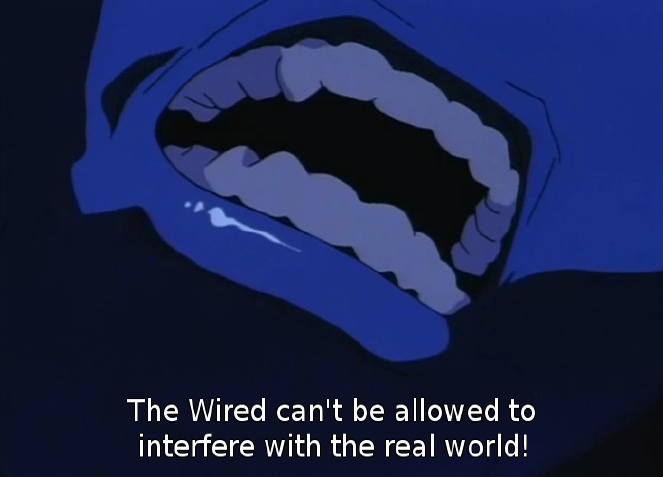
The anti-realistic visual representation of Chisa's suicide – together with the posthumous emails – anticipates a rupture that operates on multiple levels. On a visual level, the suicide is split into a gesture and a consequence, a death-act and death itself. The juxtaposition of typographies (“I . . . don't need to stay in a place like this”) both before and after Chisa's death,[3] coupled with the extreme close-up of Chisa's muttering mouth (fig. 1), suggests a communicative and even performative dimension to the suicide.


(Figure 1)

This rupture can be further developed on a narrative level, where Lain is further exposed to the split dimensions of Chisa's death. While her schoolmates gloss over Chisa's emails as if they were pranks, Lain alone recognizes the communicative gesture. Out of this curiosity, or desire, to know and communicate with the dead, Lain is initiation into the Wired world. Yet, while the communicative and traumatic converge, they do not displace the other; Lain remains haunted by Chisa's ghost made manifest in Lain's own psyche, even after talking to Chisa in the Wired world. In other words, while most schoolmates mourn the death of Chisa, it is Lain who is exposed to the dual specter of trauma: the desires to mourn (the trauma) and communicate (with the dead); but, at the same time, the incongruity of these desires.

That the two desires are incongruous is made apparent when, asked in the Wired how suicide feels, Chisa replies: “[suicide] really hurts :)”. Here, the established context of suicide works against the emphatic use of “really”. The suicide reminds audiences this conversation is occurring in the Wired – as opposed to a reality – and displaces the apparent subject (of genuine “reality”) asserted by this speech-act. Moreover, within the statement itself, the smiley – an ostensible expression of happiness – corrodes the expression of pain immediately preceding it. Juxtaposed together, the irony within this sentence points towards a more general incongruity: that post-traumatic gestures of communication must acknowledge its trauma, which nonetheless undermines what is said by underscoring the singularity of genuine expression.

It would seem that the above incongruity stems from a deferred relation between trauma and a retrospective attempt at representation, thus communication. In this sense, all mediation of trauma, whether it be media accounts or aesthetic representations, always appears post-mortem. Irony, as a challenge towards sincerity, becomes inherent in this attempt at communication, because we think of trauma as a primary event that precedes the secondary, and subsidiary, act of representation.

Yet, recent trauma studies increasingly formulates the affects of trauma as a ripple-effect,[4] i.e. how secondary trauma can be as immediate as what we conventionally consider as “primary” catastrophes. In his essay, “Trauma as Representation”, Wallace raises this question provocatively:

In other words, is representation's connection to trauma always a function of representation's capacity (or incapacity) to illustrate? Is it possible that representation's relation to trauma is not a matter of representation's ability to present again, that it is not a matter of trauma's assimilation or inassimilability as facilitated or precluded by the representational act? . . . After all, isn't it by now clear that certain representations are, in and of themselves, traumatic events? (4)

By italicizing “again”, Wallace suggests that we cannot construe the trauma-representation question in purely temporal terms, that we cannot understand (media/artistic) representation as purely secondary, because it increasingly contains part of the primary that is trauma. E. Ann Kaplan, extrapolating from Martin Hoffman's concept of vicarious trauma,[5] suggests that we can consider an over-exposure to media-images a potential kind of vicarious trauma: . . . some of the responses given by clinicians to Hoffman and Friedman's questions would suggest that visuality links cinema, victims' accounts, and therapists' responses to those accounts. In reporting their work with trauma patients, for example, therapists use language that sounds as if they were creating a film in their minds of the events people narrate . . . the border between television or movie images and the “reality” of her patients' experiences is blurred for the therapist. The comment also confirms the power of visual media to trigger symptoms of vicarious trauma, at least when the viewer is primed by treating trauma victims or by having been a victim himself or herself. (89)

Although far from conclusive, Wallace and Kaplan are formulating a reciprocal relation between media and treatments of trauma. Kaplan, through adopting the idea of vicarious trauma, asserts a continuity between trauma and media. Similarly Wallace, through denying that the trauma-representation question is always one about assimilability, asserts that there is something beyond a linear question of retrospective reference. As opposed to earlier discussions of trauma, which focuses on the impossibility of communicating trauma, recent discussions thus focus more on the overlaps between trauma and representation, and points towards the deficiency in seeing trauma as (primary) and media formulations of trauma as secondary, i.e. a linear account that reduces the trauma question from one of “transmissibility” into one of retrospective reference.

It is, then, important to understand “transmissibility” not only as what can be transmitted – which would re-invoke the question of reference – but to understand “transmissibility” also as an open space where what we conventionally think of as the secondary (the communicative, what can be meant) slips towards the primary (the traumatic, what can only be experienced), and vice versa. An understanding of “transmissibility”, then, should be reformulated in terms of this problematic temporality between media and trauma. If media does not merely seek to make sense of the catastrophe retrospectively, can a mediation of trauma by media – what I would call a media(tion) – anticipate, thus dissipate, to an extent, future traumas?

That this understanding of “transmissibility” opens up a contesting space could be better illustrated by linking two related scenes from the 1st and 11th episode of Lain (Layer 01: Weird, Layer 11: Infornography). Both scenes stem from – but also reformulate – Lain's experience of Chisa and Masami Eiri's suicide.

In layer 01, minutes after she communicates with Chisa on the Wired, we see Lain in a smoke-filled realm. Standing beside train tracks, Lain spots a girl dressed in school-uniform, with a ghastly and ever-morphing face (fig. 2).


(Figure 2)

The train rushes on and soon runs over the girl. Visual-wise, this spatializing posits Lain into a realm that is neither real nor digital. It represents, and is only representative of, a re-enactment of Chisa's death in a realm that is neither memory (because not a flashback), nor action (because nothing is done, only witnessed). This scene (among a line of other similar scenes) is what Freud would call a compulsion to repeat, a futile attempt driven by desire “to master the stimulus retrospectively” (37) – in this case, the trauma of death. With respect to the immediate visuals, then, this scene formulates a rather conventional understanding of trauma; a response-mechanism that always seeks to mediate retrospectively.

By bringing in the question of narrative and temporality, however, this scene anticipates the suicide of another individual that is yet to be narrated. In Layer 09, we are told that Masami Eiri, a god-like entity in the Wired, is also run over by a train years before Chisa's suicide.[6] Yet, already in this scene – with the juxtaposition of Chisa/Eiri's double, shifting face upon a crashing train – Eiri's suicide is anticipated and superimposed upon Chisa's. To further complicate matters, Eiri's death precedes Chisa's in the plot, but occurs after Chisa's in the narraive. In the same scene – indeed within the very image of Chisa/Eiri's unstable, shifting face – a flashback and flashforward is achieved in the same figure.

In his discussion of Resnais' traumatic cinema, Luckhurst suggests that the flashforward, as opposed to the flashback, links it “to the (im)possibility of narrating trauma in film” (190). Further on, Luckhurst observes an “intrinsic transmissibility of trauma in Resnais' work: one site seems to invoke another” (190). Temporality, then, works similarly between Resnais' works and this particular scene in Lain. First, there is indeed a “transmissibility of trauma”, in which both suicides are juxtaposed to form one traumatic image for Lain – and, implicitly, the audience. Time – as history, present experience, and future recognition – is here inter-mingled and mediated without differentiation. Chisa and Eiri's double face at once effaces and covers up the other – but they are, paradoxically, one of the same face. Lain's experience of the two vicarious traumas – one before and one after the narrative plot – thus at once repeats, anticipates and is combined. The two traumas (as external events) here accumulates and constricts upon Lain (who experiences it personally).

We hence reach this alleged “(im)possibility of narrating trauma”, precisely because it is the point where the very concept of temporality is localized and fractured. Instead of positing trauma as an event of pre-defined time and locale, it is experienced (by Lain) inversely as a compressing of such. This (im)possibility – in brackets – does not relish in any ambiguity; rather, it points towards the very transmissibility of the traumatic, propagated across time.

If in Layer 01 trauma is constricted into a single image, by Layer 11 Lain experiences trauma through mediated lenses. The episode opens with a MV-style juxtaposition of scenes from earlier layers. While devoting an episode to recap earlier footages is not uncommon,[7] Nakamura stealthily juxtaposes previously unseen (but similar) images and typographies upon other recycled images, thus at once rehashing and reformulating previous plots and narratives.

In the train-sequence in Layer 01, we see Lain imagining herself the witness of a suicide. A very similar transmission of trauma is done again in Layer 11 – but the two episodes depart in their very method of representation. Where the train-sequence signifies with its anti-realistic aesthetics, in Layer 11 the sequence questions the very reality of presentation. For the sake of analysis, I will break down the sequence into three major scenes, and illustrate by stills:

1. Cyberia Suicide

Here, the suicide of a Wired criminal (a scene from Layer 03) is recapped somewhat authentically, with Lain of “reality” being the witness of the man's death. Yet, between the scenes there are two close-ups upon Lain's eyes that do not belong to the original sequence found in Layer 03. The first image is a side-shot of Lain's left eye (fig. 3),


(Figure 3)

while the second image concludes the sequence with a slightly arced shot of Lain's right eye (fig. 4).


(Figure 4)

Not only do the two shots emphasize Lain as a first-hand witness (something which the original scene does well enough), they break down the very act of witnessing into two partial – left and right – angles, suggesting vividly the highly subjective and aporetic nature of Lain's witnessing. These two shots, then, function in a different realm – as commentaries – against the linear sequence that they interrupt.

2a. Chisa's suicide

After a brief sequence of montages that combine Lain's cityscape against wires, Chisa's suicide in Layer 01 is re-enacted, albeit with two major discrepancies. In the first, a reverse-shot of Chisa's hands show Lain standing in the scene of suicide (fig. 5).


(Figure 5)

Not only does the shot upset the established narrative, the positing of Lain into a reformulated “reality” – as opposed to an imagined realm in the train-scene – suggests a fundamental repositioning of Lain's experience of trauma. Linking scenes 1. and 2a., we can perhaps suggest that a transference has occurred where Lain's first-hand exposure to one suicide has led to her being exposed (retrospectively) to (all) other traumas. In other words, a re-exposure, that is as real as any “primary” event.

2b. Chisa's hands

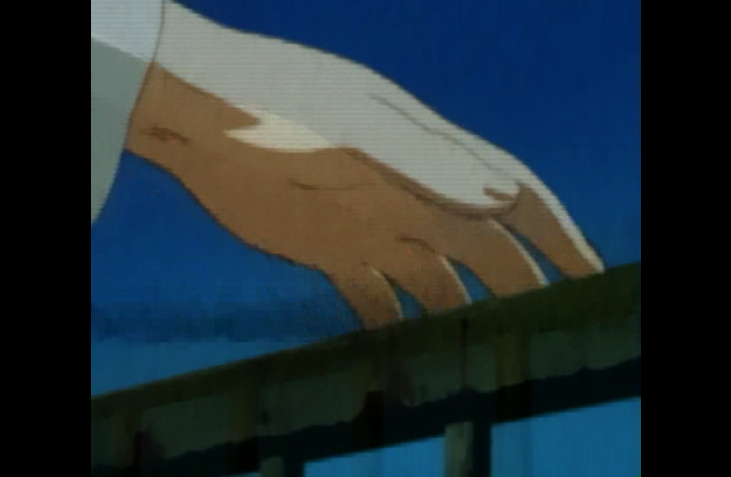
There are two continuous closeups of Chisa's hands (fig. 6 and 7). Continuous, because they proceed within the same zooming-in shot.[8] This apparent continuity works in tension against the two when we realize that the


(Figure 6)


(Figure 7)

first close-up emphasizes on the “real” (i.e. the normative) style of Lain as anime. The second close-up, however, imitates a “media” (i.e. televised) version of the self-same hand. The loosening – death-embracing – hand of Chisa thus remains constant across two media; a conclusion all the more upsetting when we realize that, on the roof-top, there is no “first-hand” witness – nor any captured footage – of Chisa's suicide. Within this animation, this continuity becomes one without witness.

What these scenes in Lain do, then, is to show how media functions as different levels of discourse that converges around the issue of trauma. The portmanteau “infornography” – the name-sake of Layer 11 – thus departs from pornography in that while the latter is an excess that is nonetheless caught in a single-dimension (a visual fetish), the former is an excess that overflows through different levels of discourse. In other words, “infornography” is the basis for which a media(tion) across various media can occur. Specifically for Lain, we see 1. a media as discussed within the context of the animation, which encompasses questions like the blurred boundary between the real and Wired world, 2. the media that the animation imitates (thus mediates) on a formal level, which includes questions like the splitting and layering of different imitations of other media.

There is a parallel relation between these first two levels of “medium”. Taro, the self-proclaimed boyfriend of Lain, remarks in Layer 03 that “[m]ost people take on a different identity in the Wired than the real world, but [Lain is] totally opposite”. He acutely observes how Lain of “reality” is completely opposite to her “Wired” self, and that the third Lain exists – conceived by others' rumors – precisely as a necessarily mediated version of this split-identity. In this sense, the split between these two levels of “medium” parallels the split of Lain's first two identities. By offering a third level to Lain's identity, Nakamura thus explores a level of media(tion) which links up the first two levels, i.e. the question of what we can locate between the communicative blur (on the first level) and the traumatic split (on the second level).

In this sense, the operation of media(tion) becomes a direct critique of certain aspects of media-culture. The inverse of media(tion), or infornography, is perhaps pornography. To justify this, we can briefly contrast animation against the popular genre of “torture porn”. In her paper on trauma and the rise of the “torture porn” genre, Hallam traces the rise of torture porn “[along] cultural fears and traumas resulting from 9/11 and the subsequent incident at Abu Ghraib” (231), and argues that “[g]raphic violence is used in order to heighten the engagement with reality and with the experience of trauma” (234). Here, Hallam formulates the cathartic effects of torture porn, which finds its cinematic precedence in directors like Sam Peckinpah. Yet, this formulation sidetracks the major concern of trauma – precisely, how a victim cannot frame the overwhelming after-effects of trauma that repeatedly haunts him/her, possibly, but not necessarily, in the form of visuality.

Torture porn series like Hostel and Saw, with their over-arching focus on (“realistic”) visual representation as trauma, mis-equates the traumatic experience to the visual traumatic. Here, while one may argue, as Wallace does, that representation itself becomes a form of trauma; the problem of “transmissibiltiy” is sidetracked. In other words, trauma is mis-taken as a one-dimensional experience; which, as we see in Lain's operation, is not quite the case. There is no inherent intersection between, say, a cutting off of a person's torso in Hostel to 9/11. Representation, in this specific case, can indeed become traumatic; but this does not imply that all representations are traumatic, nor does it engage on the problematic relation between trauma and representation in any way. This trauma becomes un-communicative, is empty, a mere over-exposure of a single level of discourse (visuals, in this case) without any context or consideration for causations, situations, and the post-traumatic. Without, in other words, addressing the foreignness of the foreign, which ultimately begs the question of communicating trauma.

At risk of stigmatizing genres, we may nonetheless formulate a certain opposition between “torture porn” and animation.[9] Anime, as a drawn-out and mediated version of reality, potentially offers us a mediation of traumatic experience. If we contend that (a part of) trauma is always located outside (a narrow, represented version) of reality, then anime – formulated as a site of mediation – points precisely towards the mediated nature of what we call “reality”.

It is precisely the multiple discourses raised by Lain's media(tion) that culminates in Lain's final decision to go through a “all-reset”, where events throughout the 13 episodes of Lain is reversed, and the Lain universe starts anew without being traumatized. This return to apparent innocence, where the events are erased; nonetheless confers no change upon Lain's identity. In other words, we cannot understand the gesture as a simple erasure of memory, for erasure of information about the traumatic suicides does not entail the erasure of the traumatic as experienced by Lain. Rather, we raise questions like what (if not memory) is forgotten, why Lain's erasure of herself from others equates with the erasure of (traumatic) events, why we are only shown how Lain is being forgotten, but not how people forgets Lain, and ultimately, how this forgetting transmits to our society.

In his chapter on the Holocaust, Jean Baudrillard formulates a reverse-process of forgetting that is eerily tangential to the “all-reset” in Lain. In this brief section, Baudrillard argues for an “artificial forgetting” that is effected by a cold medium:

Forgetting extermination is part of extermination, because it is also the extermination of memory, of history, of the social, etc. This forgetting is as essential as the event, in any case unlocatable by us, inaccessible to us in its truth. This forgetting is still too dangerous, it must be effaced by an artificial memory (today, everywhere, it is artificial memories that efface the memory of man, that efface man in his own memory). This artificial memory will be the restaging of extermination - but late, much too late for it to be able to make real waves and profoundly disturb something, and especially, especially through a medium that is itself cold, radiating forgetfulness, deterrence, and extermination in a still more systematic way, if that is possible, than the camps themselves. One no longer makes the Jews pass through the crematorium or the gas chamber, but through the sound track and image track, through the universal screen and the microprocessor. Forgetting, annihilation, finally achieves its aesthetic dimension in this way - it is achieved in retro, finally elevated here to a mass level. (49)

What Baudrillard provokes here, through the term “artificial memory”, is a continuous relation between a forgetting of what is traumatizing – i.e. a psychological process of repression, deferral and, transference – and a forgetting that is “within” the medium, mediated as a “system” that, while having its psychological basis, is inherently “cold” and dehumanized. Here, it is important to note how “artificial memory” departs from memory. This forgetting by the medium is systematic, and by arguing for its prevalence, Baudrillard seems to suggest that this collective forgetting effaces and ultimately over-rides the personal trauma experienced. In other words, where the gas chamber sums up individual deaths, the sound/image “track” is inherently conceived for and through a “cold” collective.

I would argue that an understanding of this “forgetting”, stemming from (an aporetic) memory – but soon achieved via the media as a systematic erasure – is the crux to understanding Lain's “all-reset”. Significantly, Nakamura frames Lain's erasure from Lain's privileged but partial perspective; in other words, instead of showing how the collective forgets the personal – i.e. how people forget Lain – Nakamura shows how Lain effects her own forgetting. This shift of perspective parallels Baudrillard's transition from memory to artificial memory. Moreover, the typography in Layer 11 – “No, it's nothing as ambiguous as memory” (fig. 8) – further echoes Baudrillard. There is, in other words, always other “systems” at work that is beyond the summation of personal memories.

While Baudrillard and Nakamura share similar concerns, I would argue that what Lain does is essentially accounting for Baudrillard's argument in reverse. Through assigning Lain the split-position of a human/software, Nakamura re-orients (i.e. mediates) the medium through a personal lens. Where Baudrillard discusses (the televised) media from a markedly analytic and elevated position – e.g. “you are the screen, and the TV watches you” (Baudrillard 51) – Lain is the medium that “watches” herself, as a person. Since ultimately Lain does not lose either her memories or body, we could perhaps better understand Lain's process of “artificial forgetting” – not as amnesia – but as a disconnection. Any traces of trauma are effaced when the one who experiences it (i.e. Lain) is disconnected from Lain's society at large.

Although Lain is disconnected from her society, we still see a Lain questioning herself through the TV screen (fig. 9). Lain is not so much effaced as repressed by a society that has already mis-construed her unique traumatic experience as rumors and conspiracies. Lain's incessant questioning of her self, is hence a viscious corollary to the society's apathy towards, and misconstrual of, her concerns. It is this apathy that effects the “all-reset” as a total repression; it is this repression that brings in a temporal rupture between the collective and the personal. Privileging Lain's point of view, we as audiences become a witness of how collective, artificial amnesia cannot sufficiently do away with personal trauma. Instead, the personal (as victim) is left behind – is repressed to a different “time” – in relation to a society that has “moved on”, precisely at the cost of leaving behind the victim. Thus, even when a grown-up Arisu meets Lain – who has not aged – in bodily form, i.e. in the “real” world, she cannot recognize Lain. The forgetting of trauma comes at the cost of forgetting the traumatized.

Through an animation that personifies the media, Nakamura opposes media(tion) – as a possible form of multi-discourse within the medium – to pornography, a sensationalist but always partial account of trauma. In other words, while Baudrillard sees TV-culture as a system of visual traumatic, proliferating one-dimensional images “which suggests nothing, which mesmerizes, which itself is nothing but a screen” (51); Nakamura posits Lain as an alternative media, a media(tion) – which suggests many things, which mediates, which itself contains multiple screens. Through framing the “all-reset” as a reversal, Nakamura thus points out the costs of undoing (traumatic) extermination, how this erasure is not forgetting, and how society at large – having repressed the trauma – runs the risk of re-experiencing this trauma as it once did, without knowing that what it takes to be the traumatic is, perhaps, a forgetting of previous traumas.


NOTES

1. An idea increasingly formulated by critics after Caruth's idea that different traumatic events could be transcribed with a renewed concept of history-writing, with emphasis on the psychological affects of trauma (see Caruth, also Luckhurst). Kaplan also discusses the idea of “transmissibility” in the context of a “translation” of trauma across cultures.

2. The tripartite split of Lain's identity is already planned in the early stages of Serial Experiment Lain, as drafts of three separate Lains can be found in Lain's concept art-book. There are, interestingly, certain biblical overtones in the narrative of Lain, in which Lain's initial position as a powerful being conceived by Masami Eiri (the “God” of Wired), and ultimate sacrifice of her real-world identity (the “all-reset”), parallels the Bible's narrative. But this discussion is beyond the scope of this essay.

3. Chiaki Konaka, the writer of Lain's screenplay, cites Godard's use of typography as a heavy influence. For details, see Nakamura's interview published in the Asian Movie Technical Journal HK in France. http://www.konaka.com/alice6/lain/hkint_e.html

4. I chose to compare the breaking-down of trauma/representation as primary/secondary to a ripple because, while the initial waves of a ripple stem from an “origin”, waves rebounding from the edges of the frame would in turn interfere with the said “origin”. The ripples (of trauma) are always framed because it always occurs within specific cultural contexts, and is propagated through some media.

5. Vicarious traumatization (VT), is a psychiatric formulation which describes the transference of trauma between patients and psychiatrists. Vicarious trauma can be transferred by the communicative acts like patients' recounts of the traumatic event. Symptoms of vicarious trauma include insomnia, emotional lability, sexual difficulties, among others. (See Kaplan, especially 87-91, who borrows from Hoffman's work, Trauma and the Therapist).

6. Not coincidentally, Eiri also committed suicide in order to “live” completely in the Wired realm.

7. It is, in fact, one of the dominant traditions unique to Japanese animation. Some of its conventional functions are: i) to reiterate the plot, ii) to provide a brief hiatus between two episodes, and iii) to introduce the anime to new audiences. Nakamura, however, already goes beyond this conventional mode when he includes new events and images into the sequence. The framing of this recap as a MV – with its rhythmic use of montage, jump-cuts and speeding up in accordance to the rhythm of the background music – also calls into attention the double media (a MV within an anime) of presentation.

8. There are, of course, no “zooming-ins” for animation in the filmic sense. I would argue that this is another instance in which Nakamura mediates across media through animation.

9. I am here taking torture porn as its own category instead of, say, as an example of cinema. As illustrated by recent films which include, but are not exhausted, by torture porn elements (e.g. Von Trier's Antichrist), media(tion) is by no means something restricted to animation alone. Nonetheless, a cinematic engagement of the traumatic must always be something more than the visual traumatic.

WORKS CITED

Baudrillard, Jean. “Holocaust”. Simulacra and Simulations. Trans. Sheila Faria Glaser. Ann Arbor: University of Michigan Press, 1994. 49-52. Print.

Caruth, Cathy. Unclaimed Experience. Baltimore, Maryland: Johns Hopkins University Press, 1996. Print.

Freud, Sigmund. Beyond the Pleasure Principle. Trans. James Strachey. New York: W. W. Norton & Company, Inc., 1961. Print.

Hallam, Lindsay. “Genre Cinema as Trauma Cinema: Post 9/11 Trauma and the rise of 'Torture Porn' in Recent Horror Films”. Trauma, Media, Art: New Perspectives. Ed. Mick Broderick &Antonio Traverso. Newcastle: Cambridge Scholars Publishing, 2010. 228-36. Print.

Kaplan, Ann E. “Vicarious Trauma and 'Empty' Empathy: Media Images of Rwanda and the Iraq War”. Trauma Culture: the Politics of Terror and Loss in Media and Literature. New Brunswick, New Jersey: Rutgers University Press, 2005. 87-100. Print.

Luckhurst, Roger. The Trauma Question. Abingdon: Routledge, 2008. Print.

Serial Experiments Lain.
Dir. Ryutaro Nakamura.Triangle Staff, 1998. Animation.

Wallace, Isabelle. “Trauma as Representation: A Mediation on Manet and Johns”. Trauma and Visuality in Modernity. Ed. Lisa Saltzman & Eric M. Rosenberg. Hanover: Dartmouth College Press, 2006. 3-27. Print.

Subjectivity, techno-fetishism and the dangers of identification

"[W]ho will write the software that makes this contraption useful and productive? We will. In fact, we're already doing it, each of us, every day. When we post and then tag pictures on the community photo albums [...], we are teaching the Machine to give names to images. The thickening links between caption and picture form a neural net that can learn. Think of the 100 billion times per day humans click on a Web page as a way of teaching the Machine what we think is important. Each time we forge a link between words, we teach it an idea." – Kevin, We Are The Web

The shattering of previous web platforms in the early 2000s via "Web 2.0" integrated applets has been said to have ushered in a new era of human interaction. The speed through which information can be created, collated, distributed across the physical globe appears to close the spatial divide which separates users. This process is facilitated largely through the communication of online accounts on the various "social media" on the Internet—Twitter, Facebook, Tumblr, Google, etc. It is claimed that this capacity for human communication is unprecedented. The type of romantic allusions from Kelly Kevin’s famous article We Are The Web are endemic within a movement which purports that the accelerated sharing of information is something fundamentally, humanly more than human. While the scale of information exchange is perhaps something which has no absolute equivalent in history, the process through which we engage with these medium in sharing this information—often personal, or personalized, information—is not something fundamentally different from the processes we engage in on a daily basis. Through Ryutaro Nakamura's 1998 series Serial Experiments: Lain (from hereon, the show will be referred to as Lain and the character as Lain), I hope to illustrate precisely how these new exchanges are not different from the ways through which we negotiate the exchange of our information, the conceptions which become recognized as "us," in our daily lives off the Internet and further that these cyberspace based interactions can play an illuminating role in aspects of human interaction.

Key to this idea is a reaction to the concept of the second self developed by theorists with regards to the impact of information technology on the human being. The second self is a concept of online personas being an augmentation to our physical, or "first," self. This phrase was first coined by Sherry Turkle in her 1984 book The Second Self. Researchers interested in this idea since have expanded this concept and made arguments for these second selves, and their fundamental basis being in the technology which allows their expression, being an expansion of the humanist project. Amber Case, a leading researcher in the field of "Cyborg Anthropology," has made such a case in her own research. She suggests that we are all cyborgs in the sense that our consciousness is augmented by the technologies that we interact with and that our second selves are "making us more human" (Case). She and others do caution that without proper education, these technologies and second selves can prove to be the source of anxiety and frustration among the younger generation. The problem is reduced to "not taking time for mental reflection" and thus "adequate time for the creation of self" which is described as elements such as "long-term planning" (Case).

The contention of this paper however is that our second selves are not usefully understood as positive extensions of ourselves and that they are not all that different from the selves which we construct everyday in our lives outside of the "psychological space"(Nusselder, 5) of cyberspace. Much of the discourse analyzed so far with respect to second selves is in fact inadequate in addressing the complex implications of Internet personas. The phenomenon is not merely tools in the humanist theoretical workbench; they are instead complicated mediations between ourselves with what we confront as being ourselves and this interaction with other such selves. Far more revealing and useful is the Lacanian mirror stage conception, in which the relation between the subject and images of himself can best be described in by this passage of Lacan:

The entire dialectic which I gave you as an example under the name of the mirror stage is based on the relation between, on the one hand, a certain level of tendencies which are experienced let us say, for the moment, at a certain point of life—as disconnected, discordant, in pieces—and there's always something of that that remains—and on the other hand, a unity with which it is merged and paired. It is in this that the subject knows himself for the first time as a unity, but as an alienated, virtual unity.(Lacan, 50, Book 2)

This paradigmatic framework is one which will guide us along an analysis of the nature of second selves. It should be cautioned that there is a multiplicity of these selves. There is not a unitary composition of the products of these various filters that, when aggregated, can be called a second self. It is a much more fragmentary conception—partial constructions of ourselves which are then in turn recognized by those around us as being us and return to us. This self whom/which we encounter is unitary only in a virtual sense. Through the mirror stage concept we're able to identify and analyze the salient features of the anxieties Lain experiences with respect to her encounters with such virtually unified entities. The mirror stage concept, however, only provides an illuminating role in helping us understand these encounters but does not completely explain them.

In order to understand how Lain contributes to our understanding of this relationship, it is necessary to first briefly outline the plot of Lain. It is difficult to provide a comprehensive summary of the myriad strands which run through the series so only those elements in the plot related to the main axis of this paper will be presented. The main character of the story is a young girl named Lain Iwakura and the series begins with the suicide of Chisa Yomada, one of Lain's classmates. Lain soon receives an email, which had been circulating around the school via the Wired network. The Wired is a rough equivalent to the Internet and is interfaced through degrees of integration via Navi computers. The email sent from Chisa implores the reader to commit suicide as well. The email is from Chisa and states "I have only given up my body" and she continues to live in the Wired having only abandoned her physical body.


This thread continues throughout the series with various tensions introduced in several subplots relating to the reality of the physical versus the apparently artificial Wired—most notably through the actions of Lain on the Wired and how they differ from the desires and actions of the Lain in the physical world. These tensions culminate in an explicit identity crisis on the part of Lain from which she decides to erase the memory of her from everyone in the world. An important overall theme of the series is the question of the merging of the physical world and the Wired world. This anxiety allows for various interactions to occur and possibilities explored that couldn’t happen if digital interaction was purely through an interface such as a computer. Instead, mediation can be illustrated as something larger than simply a screen.

As the series progressed, Lain's social relationships became strained as a multiplicity of online personas—all of whom resemble and are recognized as Lain (Lain is the only main character to appear in the Wired with a face but we will return to this later)—engage in activities which harm those around Lain. Early on in the series, episode 2, an online, Wired, persona of Lain makes an appearance in a nightclub. She is witnessed by a character who has taken an Accela, a pill sized machine which accelerates sensory perception, as if she is filtered by a screen. It appears that only the man on the Accela notices this detail. Lain's classmates, who are also present in the club, are shocked at the behavior of Lain. The Lain in the club appears to be very outgoing, she's wearing stylish club clothes—none of which characterize standard behavior for Lain. In fact, some of them cannot believe that it actually is her.

These classmates confront Lain the next day to confirm whether it was her or not. Lain goes with them to the same club that night and they are a little embarrassed because Lain is dressed in her school outfit. "I guess the girl we saw really wasn't Lain..." one of the classmates declares and Lain asks sardonically "Did she really look like me?" to which Lain receives an affirmative. Suddenly, gunshots break Lain's contemplative stance and the man who earlier in the episode had witnessed Lain while on Accela has just killed two people and is spouting seeming nonsense about only "[wanting] to clear [his] head" and then, upon recognizing her, begins accusing Lain of making him do what he has just done. At one point it seems that he is going to shoot Lain. Instead, Lain's demeanor suddenly changes and she tells him ominously "No matter where you go everyone's connected." Following which, the man shoots himself.

This scene is incredibly significant in that it sets in motion a theme which will reoccur throughout the series.


The anxieties expressed by Lain of the physical world with respect to the function of her online personas relate directly to her fear and confusion when these other forms of her begin to be recognized as being her. In this scene, Nakamura clearly displays these anxieties through Lain's pointed question about the club Lain's appearance and Lain's sardonic response to this other Lain's physical resemblance. Even more important is the way in which this scene resolves itself. Lain seems to transform before our eyes and becomes the Lain of the previous night, the Lain which was recognized physically as being Lain by her classmates and was recognized by the gunman as being the same person. This alternative persona of Lain, which did not appear chronologically before physical Lain


began using the Wired via her Navi to check Chisa's email, is in some sense a part of Lain and not some external entity. Here we can infer the creation of this alter-Lain as occurring with the connection of Lain into the Wired. What can we make about Lain's apparent transformation into what appears to be the Wired Lain of her own creation? We must remember the hints of anxiety sourced with the appearance of this new Lain.

This makes sense, as consciousness is "a matter of surface appearances" (Nusselder, 85). Successive self-images compiled into a virtual unity of the subject is how, as Lacan observed, the subject encounters their self. There is, however, a disconnect between the anxiety felt by Lain concerning their recognition of alter-Lain as being Lain and Lain's own recognition of alter-Lain as being herself—expressed most vividly in Lain’s taking on the characteristics of alter-Lain. In the former, Lain seems to be "[externalizing] the image that [she] has of [her] own being" (Nusselder, 85) while in the latter Lain appears to have accepted the virtual unity that the Wired Lain has contributed to an subsumed the identity as something that she could recognize as genuinely hers. This is a departure from the reaction the subject feels when confronted by their virtually unified self in that Lain actually takes on this representation as being her completely identified being. This doesn't last, however, as the show progressively builds this tension which culminates into the next scene wherein there is a confrontation between these imagined split Lains.


This confrontation reaches a climax in episode 8. Rumors are spreading across the school that Arisu, one of Lain's best friends, is having sexual fantasies about a teacher and Arisu has been told that Lain is spreading these rumors. She does not believe it because it would be uncharacteristic of Lain to behave in this way. It is significant that Arisu refuses to accept this reality because of her feeling like she knows (recognizes) Lain as being someone who would to behave this way. To Arisu, Lain is a shy, awkward and generally well mannered classmate. This changes when Arisu, in the height of a fantasy, finds that Lain is taunting her from within Arisu's room to which Arisu exclaims "It was you who told everyone! The rumors are true?!" From Arisu's perspective, Lain's derisive behavior in sharing these secret thoughts across the Wired is proof of Lain's complicity in this action.


However, this isn't so clear to Lain when she discovers that this has occurred. Lain goes into the Wired and confronts the version of herself which has been spreading the rumors about Arisu. Significantly, we cannot argue that this "Lain of the Wired" is simply a foreign, external entity which has no relation to the being it appears as. This is revealed when Lain observes that this Wired version of her is "being the things [she] hate[s] most about [herself]." When Lain attempts to strangle this other Lain, Wired Lain laughs and responds by saying "I'm committing suicide!"

In this scene Nakamura is illustrating the interconnected nature of these various representations of Lain—a theme hinted at in earlier scenes but here comes clear within this scene of frightening, frustrated terror. Lain is not simply the physical Lain whose image, solely, has been reproduced and spread throughout the Wired. Here again Lacanian frameworks are useful in understanding the dynamics of this scene. Lain recognizes herself within


the apparently physically external Wired Lain but not without the same disconnect expressed in the scene in episode 2. Lain recognizes herself and also expresses anxiety at the recognition of this Wired Lain as the actual Lain—which is an anxiety based on the actual externalized quality of the object being recognized as Lain: it appears to her as an object conceptually separate from her.[1] Again, in one sense she only "sees [her] form materialised, whole, the mirage of [herself], outside of [herself]"(Lacan, 140, Book 1). The surface appearances, the rumors spread by Wired Lain and her visual resemblance, composite to form a virtually unified image of Lain which is recognized by Lain's friends as in fact being Lain. It is important to note here that Lacan's mirror stage concept applies rather well. In this scene, Lain doesn't merge with the virtually unified image of herself but rather recognizes elements of herself within Wired Lain and recognizes the surface appearance, image, of this figure as being her but does not completely recognize herself within this image.

There is a fascinating moment in this scene where Lain, laying in bed apparently terrified by the damage being caused by the rumors spread about her friends by her, seems to be surrounded by the terrifying physical and psychological apparatus of the Wired. Electrical sparks discharge, wires flail out of control and there’s a shot of Lain and Lain’s shadow—throughout the show textured with a disturbing splatter of red blotches which flow through the shadow as if forming their own current—which grows. Lain is dressed in her bear shaped nightgown which she has worn many times at this point throughout the show, a symbol of her childlike demure which fails to defend her from the chaos around her.


This entire terrifying structure eventually fades away leaving Lain floating in a vast, silent void. This scene immediately reminds us of the claims of second selves, and accelerated information sharing in general, as function as augmentations which extend the human experience. Lain’s shadow grows, and this appears to be a correlation Nakamura is making with the increased prominence of Lain within the Wired, but this doesn’t represent a growth of Lain from her own perspective. Rather, it magnifies her isolation and results in her feeling completely isolated. Her quality as a person doesn’t feel extended, rather it feels alienated.

The penultimate anxiety of Lain's characterr is in the fact that everyone she knows and cares about—and indeed the whole world because through the Wired "Lain" becomes a household name—start to recognize this digital persona as actually being Lain. Lain asks in the final episode, if no one remembers her the real Lain—that is, if no one recognizes her and recalls her existence as Lain—then how can she say that she exists at all? Lain asserts that her entire existence is merely within the realm of those who have memory of her and this realization leads her to erase all memories of her and thereby, using the logic of the film, erasing her own existence. This initial realization occurs in a scene with Lain subsumed, presumably, completely within the Wired and having a dialogue with herself. This is a significant symbolic gesture, as one of the important themes of the entire show has been precisely Lain's relation with herself!

What can we make of Lain's apparent solution to her identity crisis? What is Nakamura trying to tell us about


the way out of the recognition/identification problems that Lain struggles with? By positioning Lain's "self" within the memories of others, this ignores the significance of Lain's own identification with the various virtual unities which she confronted and other recognized throughout the series. Lain encounters varied frustrations relating to her own ability to identify what was definitively her. She oscillates between recognizing, identifying these surface appearances as being her and a fear of falling into obscurity and disappearing when these appearances become recognized by others. The solution provided by Nakamura is unsatisfactory in addressing both elements of this crisis on the part of Lain.

Nakamura’s decision to portray Lain on the Wired as being something which can be recognized (as opposed to the anonymity of other characters) is a very interesting one. “[Japanese social networking sites] let members mask their identities, in distinct contrast to the real-name, oversharing hypothetical user on which Facebook’s business model is based” and this conflicted with the standard behavior of Japanese users which wherein “even popular bloggers, typically hide behind pseudonyms or nicknames” (Tabuchi, B1). Nakamura’s decision to remove this anonymity characteristic in Japanese society is one which we must take note of. Indeed, it is this very recognition as being Lain—although elements of Lain that Lain, recognized as elements of herself, would rather people not view—that seems to be the “avatar in a virtual world [which] may give a unified form to tendencies otherwise experienced as discordant and disturbing” (Nusselder, 91). This makes the literal confrontation between various entities appearing to us as Lain significant although this is not necessarily the only avenue through which virtual unities can be constructed as the discordant and disturbing fractures which we recognize as elements of ourselves can also come from “works of art, philosophy, handicrafts, consumer goods, instruments, machines, displays” (Nusselder, 85). The statement is made all the more powerful and convincing when the fractured elements are represented as physical appearances of Lain and all the more illustrative in the general relation of these themes to the role of social network media today.

The oscillatory process engaged by Lain is one which can shed light onto our own relations with each other and the particular role of the cybernetic psychological space. Just as we everyday negotiate our appearance through a filter of social influences, so too does the same process occur with Internet profiles. The pictures that are tagged on facebook, the ones which are untagged, the posts by friends in the "public" sphere of profiles that are deleted because they are inappropriate—all of these are part of the same negotiation process that we always go through. They are part of constructing this "self" that is recognized by others as being us and the construction of this self is a process that is not entirely, nor could it be entirely, deliberate or self-aware. These are also elements of the surface appearances so pivotal to constructing the conscious. They are part of the presentation of the "'outside' of ourselves, we make (up) our identity and become conscious of ourselves (self-conscious, self-confidence—or even self-assured)" (Nusselder, 85). Together they are the mirror stage from which a virtual unity is formed and we recognize as ourself.

Understood in this way the phenomenon of second selves through digital social media provides an opportunity to expose and further deeper processes of recognition fundamental to understanding social relations. They do not extend ourselves per se. Nor do they necessarily mediate ourselves between other people (in an extended fashion). These are both fundamental claims of the social network proponents. The developing of identity through the Internet and the various processes involved in this development are very familiar to how this development normally occurs. The Internet and the social media associated with it have certainly accelerated and amplified the way in which people interact with one another. The filters through which we sift that which gets recognized as us remain in place and are expanded through a digital avatar which is purported to be "us" and can be recognized as such—by others and by ourselves. Web 2.0, perhaps by its accelerated nature, provides an opportunity to dissect this process and through this we can reflect on how interaction functions. In this way, perhaps the proponents of these innovations in digital technology have a sound idea: the Internet is reshaping how people interact. Not through greater, qualitatively different mediations but through comparison by way of what could perhaps be described as the virtual virtual unity.


NOTES

1. And in a sense, physically as well since the physical and the Wired worlds have begun to merge by this point in the series.


WORKS CITED


Case, Amber (Actor). (2010). Amber Case: We are all cyborgs now [Web]. Available from http://www.ted.com/talks/amber_case_we_are_all_cyborgs_now.html

Kevin, Kelly. "We Are The Web." Wired, August 2005. Web. 2 Jun 2011. http://www.wired.com/wired/archive/13.08/tech.html?pg=5&topic=tech&topic_set=%3E

Lacan, Jacques. 1988a. The Seminar of Jacques Lacan, Book 2: The Ego in Freud's Theory and in the Technique of Psychoanalysis. Cambridge: Cambridge University Press.

Lacan, Jacques. 1988b. The Seminar of Jacques Lacan, Book 1: Freud's Papers on Technique. Cambridge: Cambridge University Press.

Nusselder, A. (2009). Interface Fantasy: a Lacanian Cyborg Ontology. Cambridge, MA: MIT Press.

Tabuchi, Hiroko. "Facebook Wins Relatively Few Friends in Japan." New York Times 10 Jan 2011: B1. Print.

Turkle, S. (1984). The second self: computers and the human spirit (chapter 4, adolescence and identity: finding yourself in the machine). New York: Simon and Schuster.