Serial Experiment Lain begins with the suicide of Lain's schoolmate, Chisa. Soon students receive e-mails from Chisa, telling them how one can exist in the Wired (i.e. digital) world alone. Lain, too, receives Chisa's posthumous e-mail, and is haunted by Chisa's phantom throughout the anime. There are myriad struggles in-between the 13 episodes: the dissolving boundary between online games and reality, Lain's amnesia of her doings in the Wired, rumors and conspiracy theories spreading across the internet. Lain, initiated into the Wired world, soon becomes a god-like entity (a “software”) who transcends the boundaries between reality, the Wired, and other media. In turn, Lain is mediated as an omnipresent “media-figure” in the Wired. Lain's self is correspondingly split into three (largely discontinuous) identities: 1. Lain of “reality”, amnesiac and exposed to traumatic experiences, 2. Lain of “Wired”, aggressive, transcending media boundaries and 3. Lain according to rumors and conspiracies, i.e. a third Lain rejected by 2. and 3. as not-same.[2] Increasingly aware of the porousness of identity and memory in the Wired, Lain decides to go through an “all-reset” process wherein events throughout the 13-episodes are reversed; and only Lain retains knowledge of what has happened. The suicides which acted as catalysts for the story-line are undone; and people of the Lain universe live in blissful ignorance of Lain.
The anti-realistic visual representation of Chisa's suicide – together with the posthumous emails – anticipates a rupture that operates on multiple levels. On a visual level, the suicide is split into a gesture and a consequence, a death-act and death itself. The juxtaposition of typographies (“I . . . don't need to stay in a place like this”) both before and after Chisa's death,[3] coupled with the extreme close-up of Chisa's muttering mouth (fig. 1), suggests a communicative and even performative dimension to the suicide.

(Figure 1)
This rupture can be further developed on a narrative level, where Lain is further exposed to the split dimensions of Chisa's death. While her schoolmates gloss over Chisa's emails as if they were pranks, Lain alone recognizes the communicative gesture. Out of this curiosity, or desire, to know and communicate with the dead, Lain is initiation into the Wired world. Yet, while the communicative and traumatic converge, they do not displace the other; Lain remains haunted by Chisa's ghost made manifest in Lain's own psyche, even after talking to Chisa in the Wired world. In other words, while most schoolmates mourn the death of Chisa, it is Lain who is exposed to the dual specter of trauma: the desires to mourn (the trauma) and communicate (with the dead); but, at the same time, the incongruity of these desires.
That the two desires are incongruous is made apparent when, asked in the Wired how suicide feels, Chisa replies: “[suicide] really hurts :)”. Here, the established context of suicide works against the emphatic use of “really”. The suicide reminds audiences this conversation is occurring in the Wired – as opposed to a reality – and displaces the apparent subject (of genuine “reality”) asserted by this speech-act. Moreover, within the statement itself, the smiley – an ostensible expression of happiness – corrodes the expression of pain immediately preceding it. Juxtaposed together, the irony within this sentence points towards a more general incongruity: that post-traumatic gestures of communication must acknowledge its trauma, which nonetheless undermines what is said by underscoring the singularity of genuine expression.
It would seem that the above incongruity stems from a deferred relation between trauma and a retrospective attempt at representation, thus communication. In this sense, all mediation of trauma, whether it be media accounts or aesthetic representations, always appears post-mortem. Irony, as a challenge towards sincerity, becomes inherent in this attempt at communication, because we think of trauma as a primary event that precedes the secondary, and subsidiary, act of representation.
Yet, recent trauma studies increasingly formulates the affects of trauma as a ripple-effect,[4] i.e. how secondary trauma can be as immediate as what we conventionally consider as “primary” catastrophes. In his essay, “Trauma as Representation”, Wallace raises this question provocatively:
In other words, is representation's connection to trauma always a function of representation's capacity (or incapacity) to illustrate? Is it possible that representation's relation to trauma is not a matter of representation's ability to present again, that it is not a matter of trauma's assimilation or inassimilability as facilitated or precluded by the representational act? . . . After all, isn't it by now clear that certain representations are, in and of themselves, traumatic events? (4)
By italicizing “again”, Wallace suggests that we cannot construe the trauma-representation question in purely temporal terms, that we cannot understand (media/artistic) representation as purely secondary, because it increasingly contains part of the primary that is trauma. E. Ann Kaplan, extrapolating from Martin Hoffman's concept of vicarious trauma,[5] suggests that we can consider an over-exposure to media-images a potential kind of vicarious trauma: . . . some of the responses given by clinicians to Hoffman and Friedman's questions would suggest that visuality links cinema, victims' accounts, and therapists' responses to those accounts. In reporting their work with trauma patients, for example, therapists use language that sounds as if they were creating a film in their minds of the events people narrate . . . the border between television or movie images and the “reality” of her patients' experiences is blurred for the therapist. The comment also confirms the power of visual media to trigger symptoms of vicarious trauma, at least when the viewer is primed by treating trauma victims or by having been a victim himself or herself. (89)
Although far from conclusive, Wallace and Kaplan are formulating a reciprocal relation between media and treatments of trauma. Kaplan, through adopting the idea of vicarious trauma, asserts a continuity between trauma and media. Similarly Wallace, through denying that the trauma-representation question is always one about assimilability, asserts that there is something beyond a linear question of retrospective reference. As opposed to earlier discussions of trauma, which focuses on the impossibility of communicating trauma, recent discussions thus focus more on the overlaps between trauma and representation, and points towards the deficiency in seeing trauma as (primary) and media formulations of trauma as secondary, i.e. a linear account that reduces the trauma question from one of “transmissibility” into one of retrospective reference.
It is, then, important to understand “transmissibility” not only as what can be transmitted – which would re-invoke the question of reference – but to understand “transmissibility” also as an open space where what we conventionally think of as the secondary (the communicative, what can be meant) slips towards the primary (the traumatic, what can only be experienced), and vice versa. An understanding of “transmissibility”, then, should be reformulated in terms of this problematic temporality between media and trauma. If media does not merely seek to make sense of the catastrophe retrospectively, can a mediation of trauma by media – what I would call a media(tion) – anticipate, thus dissipate, to an extent, future traumas?
That this understanding of “transmissibility” opens up a contesting space could be better illustrated by linking two related scenes from the 1st and 11th episode of Lain (Layer 01: Weird, Layer 11: Infornography). Both scenes stem from – but also reformulate – Lain's experience of Chisa and Masami Eiri's suicide.
In layer 01, minutes after she communicates with Chisa on the Wired, we see Lain in a smoke-filled realm. Standing beside train tracks, Lain spots a girl dressed in school-uniform, with a ghastly and ever-morphing face (fig. 2).

(Figure 2)
The train rushes on and soon runs over the girl. Visual-wise, this spatializing posits Lain into a realm that is neither real nor digital. It represents, and is only representative of, a re-enactment of Chisa's death in a realm that is neither memory (because not a flashback), nor action (because nothing is done, only witnessed). This scene (among a line of other similar scenes) is what Freud would call a compulsion to repeat, a futile attempt driven by desire “to master the stimulus retrospectively” (37) – in this case, the trauma of death. With respect to the immediate visuals, then, this scene formulates a rather conventional understanding of trauma; a response-mechanism that always seeks to mediate retrospectively.
By bringing in the question of narrative and temporality, however, this scene anticipates the suicide of another individual that is yet to be narrated. In Layer 09, we are told that Masami Eiri, a god-like entity in the Wired, is also run over by a train years before Chisa's suicide.[6] Yet, already in this scene – with the juxtaposition of Chisa/Eiri's double, shifting face upon a crashing train – Eiri's suicide is anticipated and superimposed upon Chisa's. To further complicate matters, Eiri's death precedes Chisa's in the plot, but occurs after Chisa's in the narraive. In the same scene – indeed within the very image of Chisa/Eiri's unstable, shifting face – a flashback and flashforward is achieved in the same figure.
In his discussion of Resnais' traumatic cinema, Luckhurst suggests that the flashforward, as opposed to the flashback, links it “to the (im)possibility of narrating trauma in film” (190). Further on, Luckhurst observes an “intrinsic transmissibility of trauma in Resnais' work: one site seems to invoke another” (190). Temporality, then, works similarly between Resnais' works and this particular scene in Lain. First, there is indeed a “transmissibility of trauma”, in which both suicides are juxtaposed to form one traumatic image for Lain – and, implicitly, the audience. Time – as history, present experience, and future recognition – is here inter-mingled and mediated without differentiation. Chisa and Eiri's double face at once effaces and covers up the other – but they are, paradoxically, one of the same face. Lain's experience of the two vicarious traumas – one before and one after the narrative plot – thus at once repeats, anticipates and is combined. The two traumas (as external events) here accumulates and constricts upon Lain (who experiences it personally).
We hence reach this alleged “(im)possibility of narrating trauma”, precisely because it is the point where the very concept of temporality is localized and fractured. Instead of positing trauma as an event of pre-defined time and locale, it is experienced (by Lain) inversely as a compressing of such. This (im)possibility – in brackets – does not relish in any ambiguity; rather, it points towards the very transmissibility of the traumatic, propagated across time.
If in Layer 01 trauma is constricted into a single image, by Layer 11 Lain experiences trauma through mediated lenses. The episode opens with a MV-style juxtaposition of scenes from earlier layers. While devoting an episode to recap earlier footages is not uncommon,[7] Nakamura stealthily juxtaposes previously unseen (but similar) images and typographies upon other recycled images, thus at once rehashing and reformulating previous plots and narratives.
In the train-sequence in Layer 01, we see Lain imagining herself the witness of a suicide. A very similar transmission of trauma is done again in Layer 11 – but the two episodes depart in their very method of representation. Where the train-sequence signifies with its anti-realistic aesthetics, in Layer 11 the sequence questions the very reality of presentation. For the sake of analysis, I will break down the sequence into three major scenes, and illustrate by stills:
1. Cyberia Suicide
Here, the suicide of a Wired criminal (a scene from Layer 03) is recapped somewhat authentically, with Lain of “reality” being the witness of the man's death. Yet, between the scenes there are two close-ups upon Lain's eyes that do not belong to the original sequence found in Layer 03. The first image is a side-shot of Lain's left eye (fig. 3),

(Figure 3)
while the second image concludes the sequence with a slightly arced shot of Lain's right eye (fig. 4).

(Figure 4)
Not only do the two shots emphasize Lain as a first-hand witness (something which the original scene does well enough), they break down the very act of witnessing into two partial – left and right – angles, suggesting vividly the highly subjective and aporetic nature of Lain's witnessing. These two shots, then, function in a different realm – as commentaries – against the linear sequence that they interrupt.
2a. Chisa's suicide
After a brief sequence of montages that combine Lain's cityscape against wires, Chisa's suicide in Layer 01 is re-enacted, albeit with two major discrepancies. In the first, a reverse-shot of Chisa's hands show Lain standing in the scene of suicide (fig. 5).

(Figure 5)
Not only does the shot upset the established narrative, the positing of Lain into a reformulated “reality” – as opposed to an imagined realm in the train-scene – suggests a fundamental repositioning of Lain's experience of trauma. Linking scenes 1. and 2a., we can perhaps suggest that a transference has occurred where Lain's first-hand exposure to one suicide has led to her being exposed (retrospectively) to (all) other traumas. In other words, a re-exposure, that is as real as any “primary” event.
2b. Chisa's hands
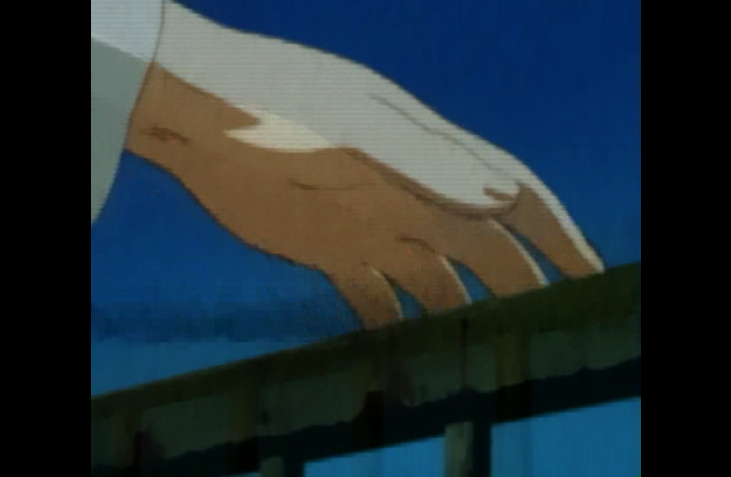
There are two continuous closeups of Chisa's hands (fig. 6 and 7). Continuous, because they proceed within the same zooming-in shot.[8] This apparent continuity works in tension against the two when we realize that the

(Figure 6)
(Figure 7)
first close-up emphasizes on the “real” (i.e. the normative) style of Lain as anime. The second close-up, however, imitates a “media” (i.e. televised) version of the self-same hand. The loosening – death-embracing – hand of Chisa thus remains constant across two media; a conclusion all the more upsetting when we realize that, on the roof-top, there is no “first-hand” witness – nor any captured footage – of Chisa's suicide. Within this animation, this continuity becomes one without witness.
What these scenes in Lain do, then, is to show how media functions as different levels of discourse that converges around the issue of trauma. The portmanteau “infornography” – the name-sake of Layer 11 – thus departs from pornography in that while the latter is an excess that is nonetheless caught in a single-dimension (a visual fetish), the former is an excess that overflows through different levels of discourse. In other words, “infornography” is the basis for which a media(tion) across various media can occur. Specifically for Lain, we see 1. a media as discussed within the context of the animation, which encompasses questions like the blurred boundary between the real and Wired world, 2. the media that the animation imitates (thus mediates) on a formal level, which includes questions like the splitting and layering of different imitations of other media.
There is a parallel relation between these first two levels of “medium”. Taro, the self-proclaimed boyfriend of Lain, remarks in Layer 03 that “[m]ost people take on a different identity in the Wired than the real world, but [Lain is] totally opposite”. He acutely observes how Lain of “reality” is completely opposite to her “Wired” self, and that the third Lain exists – conceived by others' rumors – precisely as a necessarily mediated version of this split-identity. In this sense, the split between these two levels of “medium” parallels the split of Lain's first two identities. By offering a third level to Lain's identity, Nakamura thus explores a level of media(tion) which links up the first two levels, i.e. the question of what we can locate between the communicative blur (on the first level) and the traumatic split (on the second level).
In this sense, the operation of media(tion) becomes a direct critique of certain aspects of media-culture. The inverse of media(tion), or infornography, is perhaps pornography. To justify this, we can briefly contrast animation against the popular genre of “torture porn”. In her paper on trauma and the rise of the “torture porn” genre, Hallam traces the rise of torture porn “[along] cultural fears and traumas resulting from 9/11 and the subsequent incident at Abu Ghraib” (231), and argues that “[g]raphic violence is used in order to heighten the engagement with reality and with the experience of trauma” (234). Here, Hallam formulates the cathartic effects of torture porn, which finds its cinematic precedence in directors like Sam Peckinpah. Yet, this formulation sidetracks the major concern of trauma – precisely, how a victim cannot frame the overwhelming after-effects of trauma that repeatedly haunts him/her, possibly, but not necessarily, in the form of visuality.
Torture porn series like Hostel and Saw, with their over-arching focus on (“realistic”) visual representation as trauma, mis-equates the traumatic experience to the visual traumatic. Here, while one may argue, as Wallace does, that representation itself becomes a form of trauma; the problem of “transmissibiltiy” is sidetracked. In other words, trauma is mis-taken as a one-dimensional experience; which, as we see in Lain's operation, is not quite the case. There is no inherent intersection between, say, a cutting off of a person's torso in Hostel to 9/11. Representation, in this specific case, can indeed become traumatic; but this does not imply that all representations are traumatic, nor does it engage on the problematic relation between trauma and representation in any way. This trauma becomes un-communicative, is empty, a mere over-exposure of a single level of discourse (visuals, in this case) without any context or consideration for causations, situations, and the post-traumatic. Without, in other words, addressing the foreignness of the foreign, which ultimately begs the question of communicating trauma.
At risk of stigmatizing genres, we may nonetheless formulate a certain opposition between “torture porn” and animation.[9] Anime, as a drawn-out and mediated version of reality, potentially offers us a mediation of traumatic experience. If we contend that (a part of) trauma is always located outside (a narrow, represented version) of reality, then anime – formulated as a site of mediation – points precisely towards the mediated nature of what we call “reality”.
It is precisely the multiple discourses raised by Lain's media(tion) that culminates in Lain's final decision to go through a “all-reset”, where events throughout the 13 episodes of Lain is reversed, and the Lain universe starts anew without being traumatized. This return to apparent innocence, where the events are erased; nonetheless confers no change upon Lain's identity. In other words, we cannot understand the gesture as a simple erasure of memory, for erasure of information about the traumatic suicides does not entail the erasure of the traumatic as experienced by Lain. Rather, we raise questions like what (if not memory) is forgotten, why Lain's erasure of herself from others equates with the erasure of (traumatic) events, why we are only shown how Lain is being forgotten, but not how people forgets Lain, and ultimately, how this forgetting transmits to our society.
In his chapter on the Holocaust, Jean Baudrillard formulates a reverse-process of forgetting that is eerily tangential to the “all-reset” in Lain. In this brief section, Baudrillard argues for an “artificial forgetting” that is effected by a cold medium:
Forgetting extermination is part of extermination, because it is also the extermination of memory, of history, of the social, etc. This forgetting is as essential as the event, in any case unlocatable by us, inaccessible to us in its truth. This forgetting is still too dangerous, it must be effaced by an artificial memory (today, everywhere, it is artificial memories that efface the memory of man, that efface man in his own memory). This artificial memory will be the restaging of extermination - but late, much too late for it to be able to make real waves and profoundly disturb something, and especially, especially through a medium that is itself cold, radiating forgetfulness, deterrence, and extermination in a still more systematic way, if that is possible, than the camps themselves. One no longer makes the Jews pass through the crematorium or the gas chamber, but through the sound track and image track, through the universal screen and the microprocessor. Forgetting, annihilation, finally achieves its aesthetic dimension in this way - it is achieved in retro, finally elevated here to a mass level. (49)
What Baudrillard provokes here, through the term “artificial memory”, is a continuous relation between a forgetting of what is traumatizing – i.e. a psychological process of repression, deferral and, transference – and a forgetting that is “within” the medium, mediated as a “system” that, while having its psychological basis, is inherently “cold” and dehumanized. Here, it is important to note how “artificial memory” departs from memory. This forgetting by the medium is systematic, and by arguing for its prevalence, Baudrillard seems to suggest that this collective forgetting effaces and ultimately over-rides the personal trauma experienced. In other words, where the gas chamber sums up individual deaths, the sound/image “track” is inherently conceived for and through a “cold” collective.
I would argue that an understanding of this “forgetting”, stemming from (an aporetic) memory – but soon achieved via the media as a systematic erasure – is the crux to understanding Lain's “all-reset”. Significantly, Nakamura frames Lain's erasure from Lain's privileged but partial perspective; in other words, instead of showing how the collective forgets the personal – i.e. how people forget Lain – Nakamura shows how Lain effects her own forgetting. This shift of perspective parallels Baudrillard's transition from memory to artificial memory. Moreover, the typography in Layer 11 – “No, it's nothing as ambiguous as memory” (fig. 8) – further echoes Baudrillard. There is, in other words, always other “systems” at work that is beyond the summation of personal memories.
While Baudrillard and Nakamura share similar concerns, I would argue that what Lain does is essentially accounting for Baudrillard's argument in reverse. Through assigning Lain the split-position of a human/software, Nakamura re-orients (i.e. mediates) the medium through a personal lens. Where Baudrillard discusses (the televised) media from a markedly analytic and elevated position – e.g. “you are the screen, and the TV watches you” (Baudrillard 51) – Lain is the medium that “watches” herself, as a person. Since ultimately Lain does not lose either her memories or body, we could perhaps better understand Lain's process of “artificial forgetting” – not as amnesia – but as a disconnection. Any traces of trauma are effaced when the one who experiences it (i.e. Lain) is disconnected from Lain's society at large.
Although Lain is disconnected from her society, we still see a Lain questioning herself through the TV screen (fig. 9). Lain is not so much effaced as repressed by a society that has already mis-construed her unique traumatic experience as rumors and conspiracies. Lain's incessant questioning of her self, is hence a viscious corollary to the society's apathy towards, and misconstrual of, her concerns. It is this apathy that effects the “all-reset” as a total repression; it is this repression that brings in a temporal rupture between the collective and the personal. Privileging Lain's point of view, we as audiences become a witness of how collective, artificial amnesia cannot sufficiently do away with personal trauma. Instead, the personal (as victim) is left behind – is repressed to a different “time” – in relation to a society that has “moved on”, precisely at the cost of leaving behind the victim. Thus, even when a grown-up Arisu meets Lain – who has not aged – in bodily form, i.e. in the “real” world, she cannot recognize Lain. The forgetting of trauma comes at the cost of forgetting the traumatized.
Through an animation that personifies the media, Nakamura opposes media(tion) – as a possible form of multi-discourse within the medium – to pornography, a sensationalist but always partial account of trauma. In other words, while Baudrillard sees TV-culture as a system of visual traumatic, proliferating one-dimensional images “which suggests nothing, which mesmerizes, which itself is nothing but a screen” (51); Nakamura posits Lain as an alternative media, a media(tion) – which suggests many things, which mediates, which itself contains multiple screens. Through framing the “all-reset” as a reversal, Nakamura thus points out the costs of undoing (traumatic) extermination, how this erasure is not forgetting, and how society at large – having repressed the trauma – runs the risk of re-experiencing this trauma as it once did, without knowing that what it takes to be the traumatic is, perhaps, a forgetting of previous traumas.
NOTES
1. An idea increasingly formulated by critics after Caruth's idea that different traumatic events could be transcribed with a renewed concept of history-writing, with emphasis on the psychological affects of trauma (see Caruth, also Luckhurst). Kaplan also discusses the idea of “transmissibility” in the context of a “translation” of trauma across cultures.
2. The tripartite split of Lain's identity is already planned in the early stages of Serial Experiment Lain, as drafts of three separate Lains can be found in Lain's concept art-book. There are, interestingly, certain biblical overtones in the narrative of Lain, in which Lain's initial position as a powerful being conceived by Masami Eiri (the “God” of Wired), and ultimate sacrifice of her real-world identity (the “all-reset”), parallels the Bible's narrative. But this discussion is beyond the scope of this essay.
3. Chiaki Konaka, the writer of Lain's screenplay, cites Godard's use of typography as a heavy influence. For details, see Nakamura's interview published in the Asian Movie Technical Journal HK in France. http://www.konaka.com/alice6/lain/hkint_e.html
4. I chose to compare the breaking-down of trauma/representation as primary/secondary to a ripple because, while the initial waves of a ripple stem from an “origin”, waves rebounding from the edges of the frame would in turn interfere with the said “origin”. The ripples (of trauma) are always framed because it always occurs within specific cultural contexts, and is propagated through some media.
5. Vicarious traumatization (VT), is a psychiatric formulation which describes the transference of trauma between patients and psychiatrists. Vicarious trauma can be transferred by the communicative acts like patients' recounts of the traumatic event. Symptoms of vicarious trauma include insomnia, emotional lability, sexual difficulties, among others. (See Kaplan, especially 87-91, who borrows from Hoffman's work, Trauma and the Therapist).
6. Not coincidentally, Eiri also committed suicide in order to “live” completely in the Wired realm.
7. It is, in fact, one of the dominant traditions unique to Japanese animation. Some of its conventional functions are: i) to reiterate the plot, ii) to provide a brief hiatus between two episodes, and iii) to introduce the anime to new audiences. Nakamura, however, already goes beyond this conventional mode when he includes new events and images into the sequence. The framing of this recap as a MV – with its rhythmic use of montage, jump-cuts and speeding up in accordance to the rhythm of the background music – also calls into attention the double media (a MV within an anime) of presentation.
8. There are, of course, no “zooming-ins” for animation in the filmic sense. I would argue that this is another instance in which Nakamura mediates across media through animation.
9. I am here taking torture porn as its own category instead of, say, as an example of cinema. As illustrated by recent films which include, but are not exhausted, by torture porn elements (e.g. Von Trier's Antichrist), media(tion) is by no means something restricted to animation alone. Nonetheless, a cinematic engagement of the traumatic must always be something more than the visual traumatic.
WORKS CITED
Baudrillard, Jean. “Holocaust”. Simulacra and Simulations. Trans. Sheila Faria Glaser. Ann Arbor: University of Michigan Press, 1994. 49-52. Print.
Caruth, Cathy. Unclaimed Experience. Baltimore, Maryland: Johns Hopkins University Press, 1996. Print.
Freud, Sigmund. Beyond the Pleasure Principle. Trans. James Strachey. New York: W. W. Norton & Company, Inc., 1961. Print.
Hallam, Lindsay. “Genre Cinema as Trauma Cinema: Post 9/11 Trauma and the rise of 'Torture Porn' in Recent Horror Films”. Trauma, Media, Art: New Perspectives. Ed. Mick Broderick &Antonio Traverso. Newcastle: Cambridge Scholars Publishing, 2010. 228-36. Print.
Kaplan, Ann E. “Vicarious Trauma and 'Empty' Empathy: Media Images of Rwanda and the Iraq War”. Trauma Culture: the Politics of Terror and Loss in Media and Literature. New Brunswick, New Jersey: Rutgers University Press, 2005. 87-100. Print.
Luckhurst, Roger. The Trauma Question. Abingdon: Routledge, 2008. Print.
Serial Experiments Lain. Dir. Ryutaro Nakamura.Triangle Staff, 1998. Animation.
Wallace, Isabelle. “Trauma as Representation: A Mediation on Manet and Johns”. Trauma and Visuality in Modernity. Ed. Lisa Saltzman & Eric M. Rosenberg. Hanover: Dartmouth College Press, 2006. 3-27. Print.


