Showing posts with label Lacan. Show all posts

Tuesday, June 14, 2011

The Metaphysics of Anomie in Mind Game

Mind Game, directed by Yuasa Masaaki, released in 2004, comments on the no-future dialogue of alienation and anomie present in a lot of science-fiction anime. Such anime features fraught relationships with a defamiliarized self, anxieties of future relationships to technology and society and the destruction of familiar assumptions about life, and society. Mind Game is a lighthearted comedy film which indicates alternatives to a future with no free options. It postulates a more radical sort of moral agency which resonates well with Sartre's existentialist humanist ethic of authenticity which, when applied by protagonists, allows them to transcend material conditions of society as well as materiality in itself. The ability of the characters in Mind Game to become free actors is contingent on the fictionality of their being. The gradual discovery by characters of this power over the course of the film indicates a negotiation between realist and fantastic formal pressures. As the real evaporates, the space and time characters inhabit becomes more free, enabling them as agents to achieve a more authentically free self. Mind Game attempts to destroy the real as such in order to reinscribe a humanist ethic. This goal is necessarily complicated by human subjective understanding of the “real” as precluding symbolization, but is ultimately rescued from this ontological trap by an application of the moralist aesthetic of anomal jouissance which reappropriates anomie as a positive force.

Mind Game as a film is necessarily convoluted, fitting with certain themes of universality and of the common humanity of each of dramatis personae. A detailed explication of the narrative would be prohibitively long; however, much of the plot can be reduced to the arc of three main characters. Additional thematic character detail for minor characters and antagonists is described in extended montage sequences which frame the beginning and end of the film and affect the plot only obliquely. The narrative revolves around three key protagonists whose past lives have created a situation of individualized anomie. Nishi, a 21 year old shop clerk and aspiring manga artist, becomes reunited with a childhood crush, Myon. She takes him to a yakitori restaurant owned by her father and operated by her sister, Yan. Nishi is introduced to Myon’s fiancée, and sinks into a dark introspective mood which is interrupted when two yakuza agents pursuing Myon enter the restaurant. Myon’s father has taken out a sizeable loan and, in addition, has stolen the girlfriend and world cup tickets of one of the gangsters, a soccer player named Atsu. He becomes enraged, beating Myon’s fiancée and threatening to rape her. Nishi, cowering, threatens Atsu who, in response, shoots him in the butt. Nishi dies, and his soul ascends to heaven where God mocks him for his wasted life and pathetic death, and then instructs him that his soul must now dissolve for eternity into nothingness. Nishi refuses, disobeys God, and returns to his physical body moments before death. This time, he disarms Atsu and shoots him. He steals the other Yakuza’s car, and escapes with Myon and Yan from the restaurant. They are pursued by Yakuza agents and escape by ramping off a closed bridge into the mouth of a giant whale. Inside the whale they meet Jiisan who has been trapped there for 30 years. He shows them how to make the best of a bad situation, and helps them to escape from the whale. Once free, everyone is magically transported back in time to the very beginning of the movie. Myon and Nishi are still reunited but this time Myon escapes her pursuers. While at first these characters are subjugated by values they cannot effectively control, (anomie,) they soon reinscribe those values on their own subjective terms. This synthesis alienates the viewer but ultimately describes an alternative valuating praxis.

Characters in many classic Anime films suffer from a disconnect from the values of contemporary society which appear unsustainable and alien to viewers. They often suffer from Alienation or Anomie, the symptoms of which occur as feelings of disempowerment and helplessness for characters. The origins of this alienation are described by Karl Marx in an essay on “Estranged Labor”. He describes Alienation as the process by which a laborer loses feelings of ownership of the products of his labor which, extrapolated over time, alienate him from his peers, his society, and his sense of self. He describes this process, succinctly, as occurring when “the object that labour produces, its product, stands opposed to it as something alien, as a power independent of the producer”. He describes this objectification of labor as resulting in “a loss of reality for the worker, objectification as loss of and bondage to the object, and appropriation as estrangement, as alienation [Entaussenmg]” (Marx 324). In terms which can apply outside the industrial framework of class struggle, Alienation can be seen to exist whenever a person loses connection to the norms of a society or culture. Especially in a globalized framework, it’s easy for workers to fail to understand international culture and politics in terms of an internalized referent. A society collaboratively creates the world in which it exists, but individuals within that society can lose sight of themselves within this communal framework. Thus one becomes alienated from the products of one’s labor not only in the industrialized sense but also with regards to the family, the state, and the rest of what can be called humanity. Contemporary Anime illustrates this anomie by telling stories of defamiliarized dystopias where structures of meaning, (the real,) break down in a fictionalized space, (the film,) which collapses under the weight of unsustainable norms (anomie). This symbolic killing of the real-by-proxy intends catharsis, a release from anomie.

Mind Game attempts to refute this common theme in Anime of no-future dystopianism by repositioning the fictionalized chronotope and attempting instead of destroying a symbolized real, to explode the real itself on fictional terms. This is itself symptomatic of anomie, but lacks the thematic anxieties of loss otherwise present in the genre. Many anime films, especially those produced in the science fiction or fantasy genres, feature alien futuristic landscapes which, standing in for the defamiliarized real, are collapsed or destroyed by cataclysmic forces. The moment of destruction and collapse is cathartic, and death often seems an escape from something much worse. In Akira (1988), a futuristic, post-nuclear war “Neo-Tokyo” is destroyed by an alien, transhuman menace. The city is reclaimed by the sea, and a new world begins to take shape as the credits roll. In Rintaro’s Metropolis (2001), a metaphorical babel-type society is destroyed, (again,) and from the ashes a new model of subjectivity no longer constructed around the human arises. In each case, apocalypse is viewed as a positive force which elicits and foreshadows redemption, as the phoenix, only after the rain of fire. Here the alien future stands in for an eluded-to past which, hyperbolized and extrapolated to a dystopian extreme, ceases to seem real and leaves characters with no agency or positive escape save cataclysm. Mind Game recontextualizes this apocalypse, choosing as the object of destruction not an unfamiliar future but a present where the real-as-such explodes into the symbolic and imaginary. Again, a moment of catharsis occurs and an alternative to anomie is presented which collapses the possibility of a real from which one can become alienated.

One of the first shots in Mind Game is of a young woman, Myon, running towards a closing subway train door while in the foreground Nishi types a text message reading “Your life is the result of your own decisions”. This early indulgence elucidates a primary theme in


(Figure 1)

Mind Game: the responsibility of characters as agents to behave honestly. The moral progress of characters during the film shows them learning to internalize this message by following their dreams unashamedly and without fear. Thus Nishi, who at the beginning of the movie is a resentful, no-prospects youth who only dreams of becoming a manga artist by the end of the film captures the love of his long-time crush and sets out to follow his dream job and Jiisan, trapped in a whale and filled with regret and repressed sexuality, can effectively turn back time to start again with better priorities and a wiser perspective. Each character holds a similar dream but none acts positively on their ambitions, choosing instead to respond negatively to external stimuli. Their motivations and desires are constrained by passivity and regret. Nishi complains, near the beginning of the film with regards to his feelings towards Myon, “I never had the guts to make a move, always playing it safe. Always waiting for someone to help things develop!” (Masaaki 2004) Nishi is at first afraid to act positively and is afraid of the individual commitment personal agency would require. As a result, he resents his world and is ashamed of his place it it. Characters in Mind Game do not interact authentically and are not happy until they discover a release from the oppressive norms of an alienated society.

The value for this film from a moralist perspective can be equated with the existentialist humanist ideal of authenticity as posited by Jean-Paul Sartre. Sartre claims in his lecture, “Existentialism is a Humanism” (1945) that, in the absence of a priori values, man is “nothing other than that which he makes himself”(Sartre 22). Each person is thus responsible for producing their own self. For Sartre, one must establish the self as a subject, subjectively, so as to avoid becoming self-identical, an object. He claims that those who willingly negate the self are in “bad faith” (mauvaise foi), a state he describes as an unconscious lie which one tells oneself without knowing it is told. “Bad Faith”, he claims in his text Being and Nothingness, arises when “the one to


(Figure 2)


(Figure 3)

whom the lie is told and the one who lies are one and the same person, which means that I must know in my capacity as deceiver the truth which is hidden from me in my capacity as the one deceived” (Sartre 89). Sartre claims that individuals, aware of the freedom of a synthetic world, become paralyzed by choice and, realizing the extreme responsibility of this authentic ethic, suffer from “anguish” with the weight of their own responsibility. This allows them to create systems of control which abridge agency.

Here a distinction must be made between “reality” and “the real”. The Real may deny signification, but reality, as a purely subjective phenomenon, is still defined by human perception. That which makes Sartre's ethic of authenticity so powerful, especially within the morality of Mind Game is the claim that, in the absence of a priori givens, the subject is defined exclusively as consciousness and that, even including a perception of the “real” as such, “the only level on which we can locate the refusal of the subject is that of the censor.” (Being, 93). The ethic is exclusively subjectivist, and therefore has more power in fictionalized space, when engaging with “reality”. In the universe of Mind Game, characters are more radically free than they at first are led to believe. Characters deceive themselves as to their own constraints as actors, not only on the social performative level, but physically as well. Characters discover that their assumptions about the possible aren't grounded in fact. A telling example comes in the opening montage where Jiisan, coming into his sexuality as a transgendered being, goes to church and sees images of hell which cause him to repress his natural impulses. When he meets Myon inside the whale, she helps him to actualize a more positive performance of gender and of sex than was previously possible. He starts to wear makeup, and allows himself to be aroused by Nishi's body. The film also allows the laws of physics to be called into question. In an early scene, a yakuza agent pursuing Nishi & Co. as they escape by car from the restaurant falls from a speeding vehicle to the ground. Instead of a moment of brief, permanent violence as the body, constrained by laws of inertia, is destroyed, the man runs alongside the car. On his face, a moment of confusion gives way to a smug smile. He has discovered that he can defy the laws of physics. The claim of the film is that such things were always possible, but were assumed not to be. The protagonists' desperate struggle as the film progresses reveals new kind of agency outside the limitations of realist space and time which allows them to, by staying true to themselves, follow their dreams.

The moral claim of Mind Game is contingent on the existence of a fictionalized space. As characters in cartoons, the protagonists can bend time and space. This textuality is eluded to at the end of the movie, when the text message in the beginning of the film, “your life is the result of your own decisions” is replaced by another in an alternate timeline, “the story has never ended”. This message is explicitly stated before the end credits. As an animated film, Mind Game problematizes the concept of “reality” as such by postulating a chronotope where natural givens, such


(Figure 4)

as the way things look, feel, or sound, no longer exist. This concept resonates with a theory postulated by Susan Napier, one of the West's foremost Anime theorists, who claims, in a talk on the “problem of existence in Japanese animation” that animation as a medium creates “a constant state of mutability and flux, and that the division between the world of mutability, dreams, and the unconscious, and the hard-and-fast 'real'”. In an animated movie, the limitations of the text are those of the medium. Thus much that is possible depends on aesthetic choice and formal constraints.


(Figure 5)

The metatextuality of Mind Game allows its characters hitherto impossible degrees of radical freedom. That the limits of their physical beings is defined by their animators allies within the text the values of aesthetics and of metaphysics and the “real”. That the animators appear to let their creations play with the real in the film creates interesting implications for the aesthetic theory of jouissance. First popularized by Jacques Lacan and later expanded upon by, among others, Slavoz Zizek and Roland Barthes, jouissance is often described in sexual terms and is characterized as a moment of orgasm (often translated as “bliss”) which transgresses moral principles of appropriate pleasure but which excites a person to a point at which thought and identity seem to dissolve. Roland Barthes, in his late book "The Pleasure of the Text", describes the Lacanian jouissance as being a kind of sublime act of pleasure which destroys the conscious self. Barthes recontextualizes this moral discourse to illustrate an aesthetic argument. Jouissance is for him “the abrupt loss of sociality, and yet there follows no recurrence to the subject (subjectivity), the person, solitude: everything is lost, integrally.”(Barthes 39). Reading texts can give pleasure (jouir) but true bliss (jouissance) can only be described subjectively, as, within a neutral, unstructured space, the reader freely defines their own enjoyment. He attempts to describe the nature of bliss several times throughout the book, but always recoils: “"I can only circle such a subject - and therefore better to do it briefly and in solitude than collectively and interminably; better to renounce the passage from value, the basis of the assertion, to values, which are effects of culture" (34). Barthes describes this form of aesthetic enjoyment as being purely abstract and metaphysical; his aim is to escape the normative and the political aspects of writing and of reading as acts which he attempts to accomplish by positing this sort of normless, utterly individualistic form of pleasure. Within the free space of the text, any sort of interpretation is possible, readers can play freely with the ideas, situations, and characters of the text.

In a way, the characters in Mind Game are allowed the same degree of freedom as a reader of a text; constrained only by the deliberately flexible boundaries of the medium of animated film itself. Barthes claims that the end of jouissance as a textual praxis allows the reader to reapproach


(Figure 6)


(Figure 7)


their own subjectivity as an assumed reality which otherwise does not exist.“perhaps [after jouissance] the subject returns, not as illusion, but as fiction. A certain pleasure is derived from a way of imagining oneself as individual, of inventing a final, rarest fiction: the fictive identity.”(62) A central scene in Mind Game, both textually and for the narrative, shows the protagonists trapped in the whale at play. They are animated kaleidoscopically. Yan, accompanied by the Nishi, Myon, and Jiisan, performs an elaborate, heavily sexualized dance. In one part, she wears balloons, filled with water, across her


(Figure 8)

chest invoking disproportionate breasts. The balloons expand, filled with water from pumps and also with tiny baby dolls, until they burst in a way evocative of childbirth. Nishi and Jiisan strap meter-long bamboo rods to their crotches and swing around, the women dance on top in a parody of sex. Engaging the animated quality of the subject, Yan creates a collage where she throws her painted body onto a spinning canvas so that, when rotated, the moving image is of her running while her form moves as if rotoscoped. Their performance is ironic, an exercise of play in the glory of the repressed. The final scene, once the protagonists escape from the whale and after Jiisan's time-turning clock belt rewinds the past to give the team a “Second chance”, implies that in the future any number of things can occur. The tone is optimistic. For the protagonists to achieve this freedom, they must first acknowledge their own fictionality, in order to experience Jouissance. Their play reappropraites the body as a positive but anomal source of self which can escape negative or external definition. Here the aesthetic and the metaphysical become allied with the moral and that which is real can be defined to fit the conventions of a text in order to describe a humanist ethic which values individualist agency and collaborative gain. This “play” of the real and of the self within the real can be seen as an attempt to refute or provide alternatives to anomie as tragedy. Characters are differentiated and individualized, but are presented as persisting surrounded by individuals. Cooperation is privileged, as in the final scene of escape, as a means of reconstituting a community along more sustainable ethical lines. Pre-existing sources of meaning are destroyed or reappropriated away from models of the real outside the text. Characters are reunited with each other and with their own fictive selves such that the alienation established at the start of the film is by the end abolished.

Given that for characters in Mind Game the free agency of the denouement is only available because as moral actors they have come to understand of themselves as fictional and have thus exploded the real as symbolic and as a outer limit to human agency, it remains to be seen whether the film can posit an effective moral alternative to symptoms of anomie and whether it is constructive for real human beings to imagine themselves as fictional. The agency, morality, and communality as a refutation of the aesthetics of anomie for protagonists of Mind Game is entirely contingent on their fictionality; the film attempts to combine the real as symbolic with the real as such by extending a metaphysical claim of textuality (“the story has never ended”) into the plane of the real outside the film proper. In doing so, however, Mind Game only serves to reinforce its own artificiality and to re-inscribe the permanent nature of the real.

We return to Lacan for our definition of the Real, as something which according to Zizek, “resists symbolization, dialecticization, persisting in its place, always returning to it”(181). By this taxonomy, the “brute, pre-symbolic reality”(the real) is contrasted with that which “structures our perception of reality” (the symbolic) and with that which has “no real existence but [is] a mere structural effect” and which can be called “the imaginary” (182). The Real, in Lacanian terms, however, is not only that which precludes symbolization but also that which is defined by it: “The real is simultaneously presupposed and posed by the symbolic” (191), Zizek notes, and therefore, is a “Sublime object” (192). By this logic, though Mind Game may explode the real as symbolic, its contingent status as text precludes engaging the real as sublime which is necessarily reinforced by its own symbolization. However, if we uphold the subjectivist ethic proposed by Sartre, the Real exists only insofar as human consciousness holds in faith that it is fact. Regardless, by acknowledging that the film is fictional, one extracts negatively a symbolic conception of the Real which is inescapable at least on symbolic terms.

Though the film may fail to refute the real as affecting actual human life, (here again the distinction appears – Nishi is fictional, you are not,) There still exists a claim to moral agency in the performance of the text as fictional. By collapsing taxonomizing boundaries between the moral and the aesthetic, we can experience the pleasure of the film as jouissance as being a positive moral act which can refute Anomie. Here, though the self may still exist and the constrictive boundaries of the real may still proscribe communal agency, we may experience value as “shifted to the sumptuous rank of the signifier” (Barthes 65) as being artificial and neutered by the pleasure of text. By combining the act of reading with the experience of the subjective jouissance, we can escape norms and reapproach culture and society in a genuine and authentic manner. Here Sartre can be shown to agree: “What art and morality have in common is creation and invention” (Existentialism, 46).


(Figure 9)


(Figure 10)

The narrative of the film is framed by two extended sequences of montage. The first uses sinister-sounding music and a washed-out color palette to provide backstory on each of the dramatis personae. It appears fractured and ugly. At the end of the film, after the conceptual shift, this montage is recapitulated. e music is changed, and the colors are restored. The narrative is now longer, more holistic. The narrative has in a way been mended, foreshadowing an open future which escapes the somewhat cliché tropes of the narrative but allows for a new kind of agency within text. The moment of catharsis arrives not as the story is concluded, but as it is revealed to continue outside the film. Temporality and spatiality have become fluid, and the only tangible limit on human agency is the self. From an experience of anguish in bad faith, the protagonists leave regret and shame behind, entering into a freer space defined by jouissance where the aesthetic, moral, and the real align in a fictionalized space which problematizes the “real” as such and postulates an escape from a no-future dystopian ethic. Taxonomizing boundaries dissolve and new kinds of being are in mind game synthesized, creating new possibilities and realities which resemble alienation but are embraced by the self of the protagonists, abandoning old ontologies to exist in a new world of their own creation.

Though Mind Game fails to resolve palpable real-world problems of alienation and anomie, it allows for a change of perspective where, though the Real still exists as a sublime object, a new understanding of the powers of subjectivity neuters the real as symbolized and allows the union of the moral and the aesthetic within an anomal, subjective space under a heuristic of self-indulgent jouissance. Given that the Real may still exist but that it is surrounded by symbolization, Mind Game contends that one can play freely with the norms of society, which are described as holding the same metaphysical weight as a piece of fiction. If Being is text and the self is alienated, the only recourse is subjectivity.


BIBLIOGRAPHY

Mind Game. Dir. Masaaki Yuasa. Studio 4.C, 2004. DVD.

Marx, Karl. Early Writings. London. u.a.: Penguin, 1992. Web. .

Barthes, Roland. The Pleasure of the Text. Trans. Richard Miller and Richard Howard. New York: Hill and Wang, 1975. Print.

Napier, Susan. "The Problem of Existence in Japanese Anime." Lecture. 24 Apr. 2003. Jstor. Web. 17 Apr. 2011. .

Sartre, Jean-Paul. Existentialism is a Humanism. Trans. Carol Macomber. Yale University, 2007. Print.

Sartre, Jean-Paul. Being and Nothingness: a Phenomenological Essay on Ontology. Trans. Hazel Estella. Barnes. New York: Washington Square, 1992. Print.

Zizek, Slavoj. The Sublime Object of Ideology. London: Verso, 2008. Print.

Monday, June 13, 2011

Subjectivity, techno-fetishism and the dangers of identification

"[W]ho will write the software that makes this contraption useful and productive? We will. In fact, we're already doing it, each of us, every day. When we post and then tag pictures on the community photo albums [...], we are teaching the Machine to give names to images. The thickening links between caption and picture form a neural net that can learn. Think of the 100 billion times per day humans click on a Web page as a way of teaching the Machine what we think is important. Each time we forge a link between words, we teach it an idea." – Kevin, We Are The Web

The shattering of previous web platforms in the early 2000s via "Web 2.0" integrated applets has been said to have ushered in a new era of human interaction. The speed through which information can be created, collated, distributed across the physical globe appears to close the spatial divide which separates users. This process is facilitated largely through the communication of online accounts on the various "social media" on the Internet—Twitter, Facebook, Tumblr, Google, etc. It is claimed that this capacity for human communication is unprecedented. The type of romantic allusions from Kelly Kevin’s famous article We Are The Web are endemic within a movement which purports that the accelerated sharing of information is something fundamentally, humanly more than human. While the scale of information exchange is perhaps something which has no absolute equivalent in history, the process through which we engage with these medium in sharing this information—often personal, or personalized, information—is not something fundamentally different from the processes we engage in on a daily basis. Through Ryutaro Nakamura's 1998 series Serial Experiments: Lain (from hereon, the show will be referred to as Lain and the character as Lain), I hope to illustrate precisely how these new exchanges are not different from the ways through which we negotiate the exchange of our information, the conceptions which become recognized as "us," in our daily lives off the Internet and further that these cyberspace based interactions can play an illuminating role in aspects of human interaction.

Key to this idea is a reaction to the concept of the second self developed by theorists with regards to the impact of information technology on the human being. The second self is a concept of online personas being an augmentation to our physical, or "first," self. This phrase was first coined by Sherry Turkle in her 1984 book The Second Self. Researchers interested in this idea since have expanded this concept and made arguments for these second selves, and their fundamental basis being in the technology which allows their expression, being an expansion of the humanist project. Amber Case, a leading researcher in the field of "Cyborg Anthropology," has made such a case in her own research. She suggests that we are all cyborgs in the sense that our consciousness is augmented by the technologies that we interact with and that our second selves are "making us more human" (Case). She and others do caution that without proper education, these technologies and second selves can prove to be the source of anxiety and frustration among the younger generation. The problem is reduced to "not taking time for mental reflection" and thus "adequate time for the creation of self" which is described as elements such as "long-term planning" (Case).

The contention of this paper however is that our second selves are not usefully understood as positive extensions of ourselves and that they are not all that different from the selves which we construct everyday in our lives outside of the "psychological space"(Nusselder, 5) of cyberspace. Much of the discourse analyzed so far with respect to second selves is in fact inadequate in addressing the complex implications of Internet personas. The phenomenon is not merely tools in the humanist theoretical workbench; they are instead complicated mediations between ourselves with what we confront as being ourselves and this interaction with other such selves. Far more revealing and useful is the Lacanian mirror stage conception, in which the relation between the subject and images of himself can best be described in by this passage of Lacan:

The entire dialectic which I gave you as an example under the name of the mirror stage is based on the relation between, on the one hand, a certain level of tendencies which are experienced let us say, for the moment, at a certain point of life—as disconnected, discordant, in pieces—and there's always something of that that remains—and on the other hand, a unity with which it is merged and paired. It is in this that the subject knows himself for the first time as a unity, but as an alienated, virtual unity.(Lacan, 50, Book 2)

This paradigmatic framework is one which will guide us along an analysis of the nature of second selves. It should be cautioned that there is a multiplicity of these selves. There is not a unitary composition of the products of these various filters that, when aggregated, can be called a second self. It is a much more fragmentary conception—partial constructions of ourselves which are then in turn recognized by those around us as being us and return to us. This self whom/which we encounter is unitary only in a virtual sense. Through the mirror stage concept we're able to identify and analyze the salient features of the anxieties Lain experiences with respect to her encounters with such virtually unified entities. The mirror stage concept, however, only provides an illuminating role in helping us understand these encounters but does not completely explain them.

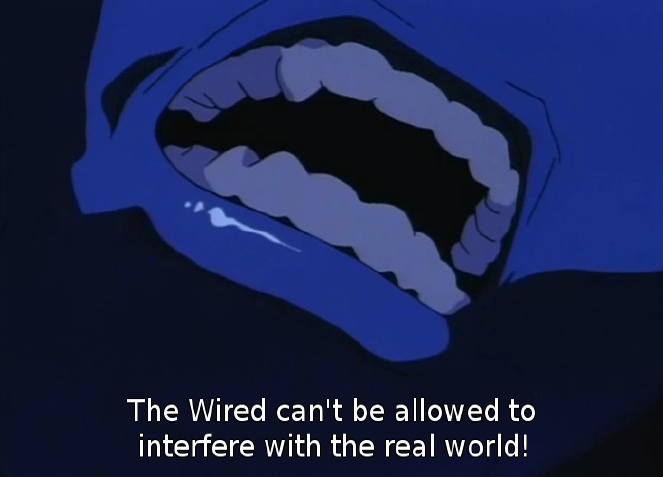
In order to understand how Lain contributes to our understanding of this relationship, it is necessary to first briefly outline the plot of Lain. It is difficult to provide a comprehensive summary of the myriad strands which run through the series so only those elements in the plot related to the main axis of this paper will be presented. The main character of the story is a young girl named Lain Iwakura and the series begins with the suicide of Chisa Yomada, one of Lain's classmates. Lain soon receives an email, which had been circulating around the school via the Wired network. The Wired is a rough equivalent to the Internet and is interfaced through degrees of integration via Navi computers. The email sent from Chisa implores the reader to commit suicide as well. The email is from Chisa and states "I have only given up my body" and she continues to live in the Wired having only abandoned her physical body.


This thread continues throughout the series with various tensions introduced in several subplots relating to the reality of the physical versus the apparently artificial Wired—most notably through the actions of Lain on the Wired and how they differ from the desires and actions of the Lain in the physical world. These tensions culminate in an explicit identity crisis on the part of Lain from which she decides to erase the memory of her from everyone in the world. An important overall theme of the series is the question of the merging of the physical world and the Wired world. This anxiety allows for various interactions to occur and possibilities explored that couldn’t happen if digital interaction was purely through an interface such as a computer. Instead, mediation can be illustrated as something larger than simply a screen.

As the series progressed, Lain's social relationships became strained as a multiplicity of online personas—all of whom resemble and are recognized as Lain (Lain is the only main character to appear in the Wired with a face but we will return to this later)—engage in activities which harm those around Lain. Early on in the series, episode 2, an online, Wired, persona of Lain makes an appearance in a nightclub. She is witnessed by a character who has taken an Accela, a pill sized machine which accelerates sensory perception, as if she is filtered by a screen. It appears that only the man on the Accela notices this detail. Lain's classmates, who are also present in the club, are shocked at the behavior of Lain. The Lain in the club appears to be very outgoing, she's wearing stylish club clothes—none of which characterize standard behavior for Lain. In fact, some of them cannot believe that it actually is her.

These classmates confront Lain the next day to confirm whether it was her or not. Lain goes with them to the same club that night and they are a little embarrassed because Lain is dressed in her school outfit. "I guess the girl we saw really wasn't Lain..." one of the classmates declares and Lain asks sardonically "Did she really look like me?" to which Lain receives an affirmative. Suddenly, gunshots break Lain's contemplative stance and the man who earlier in the episode had witnessed Lain while on Accela has just killed two people and is spouting seeming nonsense about only "[wanting] to clear [his] head" and then, upon recognizing her, begins accusing Lain of making him do what he has just done. At one point it seems that he is going to shoot Lain. Instead, Lain's demeanor suddenly changes and she tells him ominously "No matter where you go everyone's connected." Following which, the man shoots himself.

This scene is incredibly significant in that it sets in motion a theme which will reoccur throughout the series.


The anxieties expressed by Lain of the physical world with respect to the function of her online personas relate directly to her fear and confusion when these other forms of her begin to be recognized as being her. In this scene, Nakamura clearly displays these anxieties through Lain's pointed question about the club Lain's appearance and Lain's sardonic response to this other Lain's physical resemblance. Even more important is the way in which this scene resolves itself. Lain seems to transform before our eyes and becomes the Lain of the previous night, the Lain which was recognized physically as being Lain by her classmates and was recognized by the gunman as being the same person. This alternative persona of Lain, which did not appear chronologically before physical Lain


began using the Wired via her Navi to check Chisa's email, is in some sense a part of Lain and not some external entity. Here we can infer the creation of this alter-Lain as occurring with the connection of Lain into the Wired. What can we make about Lain's apparent transformation into what appears to be the Wired Lain of her own creation? We must remember the hints of anxiety sourced with the appearance of this new Lain.

This makes sense, as consciousness is "a matter of surface appearances" (Nusselder, 85). Successive self-images compiled into a virtual unity of the subject is how, as Lacan observed, the subject encounters their self. There is, however, a disconnect between the anxiety felt by Lain concerning their recognition of alter-Lain as being Lain and Lain's own recognition of alter-Lain as being herself—expressed most vividly in Lain’s taking on the characteristics of alter-Lain. In the former, Lain seems to be "[externalizing] the image that [she] has of [her] own being" (Nusselder, 85) while in the latter Lain appears to have accepted the virtual unity that the Wired Lain has contributed to an subsumed the identity as something that she could recognize as genuinely hers. This is a departure from the reaction the subject feels when confronted by their virtually unified self in that Lain actually takes on this representation as being her completely identified being. This doesn't last, however, as the show progressively builds this tension which culminates into the next scene wherein there is a confrontation between these imagined split Lains.


This confrontation reaches a climax in episode 8. Rumors are spreading across the school that Arisu, one of Lain's best friends, is having sexual fantasies about a teacher and Arisu has been told that Lain is spreading these rumors. She does not believe it because it would be uncharacteristic of Lain to behave in this way. It is significant that Arisu refuses to accept this reality because of her feeling like she knows (recognizes) Lain as being someone who would to behave this way. To Arisu, Lain is a shy, awkward and generally well mannered classmate. This changes when Arisu, in the height of a fantasy, finds that Lain is taunting her from within Arisu's room to which Arisu exclaims "It was you who told everyone! The rumors are true?!" From Arisu's perspective, Lain's derisive behavior in sharing these secret thoughts across the Wired is proof of Lain's complicity in this action.


However, this isn't so clear to Lain when she discovers that this has occurred. Lain goes into the Wired and confronts the version of herself which has been spreading the rumors about Arisu. Significantly, we cannot argue that this "Lain of the Wired" is simply a foreign, external entity which has no relation to the being it appears as. This is revealed when Lain observes that this Wired version of her is "being the things [she] hate[s] most about [herself]." When Lain attempts to strangle this other Lain, Wired Lain laughs and responds by saying "I'm committing suicide!"

In this scene Nakamura is illustrating the interconnected nature of these various representations of Lain—a theme hinted at in earlier scenes but here comes clear within this scene of frightening, frustrated terror. Lain is not simply the physical Lain whose image, solely, has been reproduced and spread throughout the Wired. Here again Lacanian frameworks are useful in understanding the dynamics of this scene. Lain recognizes herself within


the apparently physically external Wired Lain but not without the same disconnect expressed in the scene in episode 2. Lain recognizes herself and also expresses anxiety at the recognition of this Wired Lain as the actual Lain—which is an anxiety based on the actual externalized quality of the object being recognized as Lain: it appears to her as an object conceptually separate from her.[1] Again, in one sense she only "sees [her] form materialised, whole, the mirage of [herself], outside of [herself]"(Lacan, 140, Book 1). The surface appearances, the rumors spread by Wired Lain and her visual resemblance, composite to form a virtually unified image of Lain which is recognized by Lain's friends as in fact being Lain. It is important to note here that Lacan's mirror stage concept applies rather well. In this scene, Lain doesn't merge with the virtually unified image of herself but rather recognizes elements of herself within Wired Lain and recognizes the surface appearance, image, of this figure as being her but does not completely recognize herself within this image.

There is a fascinating moment in this scene where Lain, laying in bed apparently terrified by the damage being caused by the rumors spread about her friends by her, seems to be surrounded by the terrifying physical and psychological apparatus of the Wired. Electrical sparks discharge, wires flail out of control and there’s a shot of Lain and Lain’s shadow—throughout the show textured with a disturbing splatter of red blotches which flow through the shadow as if forming their own current—which grows. Lain is dressed in her bear shaped nightgown which she has worn many times at this point throughout the show, a symbol of her childlike demure which fails to defend her from the chaos around her.


This entire terrifying structure eventually fades away leaving Lain floating in a vast, silent void. This scene immediately reminds us of the claims of second selves, and accelerated information sharing in general, as function as augmentations which extend the human experience. Lain’s shadow grows, and this appears to be a correlation Nakamura is making with the increased prominence of Lain within the Wired, but this doesn’t represent a growth of Lain from her own perspective. Rather, it magnifies her isolation and results in her feeling completely isolated. Her quality as a person doesn’t feel extended, rather it feels alienated.

The penultimate anxiety of Lain's characterr is in the fact that everyone she knows and cares about—and indeed the whole world because through the Wired "Lain" becomes a household name—start to recognize this digital persona as actually being Lain. Lain asks in the final episode, if no one remembers her the real Lain—that is, if no one recognizes her and recalls her existence as Lain—then how can she say that she exists at all? Lain asserts that her entire existence is merely within the realm of those who have memory of her and this realization leads her to erase all memories of her and thereby, using the logic of the film, erasing her own existence. This initial realization occurs in a scene with Lain subsumed, presumably, completely within the Wired and having a dialogue with herself. This is a significant symbolic gesture, as one of the important themes of the entire show has been precisely Lain's relation with herself!

What can we make of Lain's apparent solution to her identity crisis? What is Nakamura trying to tell us about


the way out of the recognition/identification problems that Lain struggles with? By positioning Lain's "self" within the memories of others, this ignores the significance of Lain's own identification with the various virtual unities which she confronted and other recognized throughout the series. Lain encounters varied frustrations relating to her own ability to identify what was definitively her. She oscillates between recognizing, identifying these surface appearances as being her and a fear of falling into obscurity and disappearing when these appearances become recognized by others. The solution provided by Nakamura is unsatisfactory in addressing both elements of this crisis on the part of Lain.

Nakamura’s decision to portray Lain on the Wired as being something which can be recognized (as opposed to the anonymity of other characters) is a very interesting one. “[Japanese social networking sites] let members mask their identities, in distinct contrast to the real-name, oversharing hypothetical user on which Facebook’s business model is based” and this conflicted with the standard behavior of Japanese users which wherein “even popular bloggers, typically hide behind pseudonyms or nicknames” (Tabuchi, B1). Nakamura’s decision to remove this anonymity characteristic in Japanese society is one which we must take note of. Indeed, it is this very recognition as being Lain—although elements of Lain that Lain, recognized as elements of herself, would rather people not view—that seems to be the “avatar in a virtual world [which] may give a unified form to tendencies otherwise experienced as discordant and disturbing” (Nusselder, 91). This makes the literal confrontation between various entities appearing to us as Lain significant although this is not necessarily the only avenue through which virtual unities can be constructed as the discordant and disturbing fractures which we recognize as elements of ourselves can also come from “works of art, philosophy, handicrafts, consumer goods, instruments, machines, displays” (Nusselder, 85). The statement is made all the more powerful and convincing when the fractured elements are represented as physical appearances of Lain and all the more illustrative in the general relation of these themes to the role of social network media today.

The oscillatory process engaged by Lain is one which can shed light onto our own relations with each other and the particular role of the cybernetic psychological space. Just as we everyday negotiate our appearance through a filter of social influences, so too does the same process occur with Internet profiles. The pictures that are tagged on facebook, the ones which are untagged, the posts by friends in the "public" sphere of profiles that are deleted because they are inappropriate—all of these are part of the same negotiation process that we always go through. They are part of constructing this "self" that is recognized by others as being us and the construction of this self is a process that is not entirely, nor could it be entirely, deliberate or self-aware. These are also elements of the surface appearances so pivotal to constructing the conscious. They are part of the presentation of the "'outside' of ourselves, we make (up) our identity and become conscious of ourselves (self-conscious, self-confidence—or even self-assured)" (Nusselder, 85). Together they are the mirror stage from which a virtual unity is formed and we recognize as ourself.

Understood in this way the phenomenon of second selves through digital social media provides an opportunity to expose and further deeper processes of recognition fundamental to understanding social relations. They do not extend ourselves per se. Nor do they necessarily mediate ourselves between other people (in an extended fashion). These are both fundamental claims of the social network proponents. The developing of identity through the Internet and the various processes involved in this development are very familiar to how this development normally occurs. The Internet and the social media associated with it have certainly accelerated and amplified the way in which people interact with one another. The filters through which we sift that which gets recognized as us remain in place and are expanded through a digital avatar which is purported to be "us" and can be recognized as such—by others and by ourselves. Web 2.0, perhaps by its accelerated nature, provides an opportunity to dissect this process and through this we can reflect on how interaction functions. In this way, perhaps the proponents of these innovations in digital technology have a sound idea: the Internet is reshaping how people interact. Not through greater, qualitatively different mediations but through comparison by way of what could perhaps be described as the virtual virtual unity.


NOTES

1. And in a sense, physically as well since the physical and the Wired worlds have begun to merge by this point in the series.


WORKS CITED


Case, Amber (Actor). (2010). Amber Case: We are all cyborgs now [Web]. Available from http://www.ted.com/talks/amber_case_we_are_all_cyborgs_now.html

Kevin, Kelly. "We Are The Web." Wired, August 2005. Web. 2 Jun 2011. http://www.wired.com/wired/archive/13.08/tech.html?pg=5&topic=tech&topic_set=%3E

Lacan, Jacques. 1988a. The Seminar of Jacques Lacan, Book 2: The Ego in Freud's Theory and in the Technique of Psychoanalysis. Cambridge: Cambridge University Press.

Lacan, Jacques. 1988b. The Seminar of Jacques Lacan, Book 1: Freud's Papers on Technique. Cambridge: Cambridge University Press.

Nusselder, A. (2009). Interface Fantasy: a Lacanian Cyborg Ontology. Cambridge, MA: MIT Press.

Tabuchi, Hiroko. "Facebook Wins Relatively Few Friends in Japan." New York Times 10 Jan 2011: B1. Print.

Turkle, S. (1984). The second self: computers and the human spirit (chapter 4, adolescence and identity: finding yourself in the machine). New York: Simon and Schuster.

Language As Limitation and Possibility in The Sky Crawlers

Kildren are a class of biogenetically-engineered humans whose sole purpose in life is to fly war planes. When they die, they are reincarnated, former memories of their past life erased. Mamoru Oshii’s anime The Sky Crawlers is set in an alternate universe where wars are between corporations, not nations. As such, countrymen no longer have a sense of duty to fight for their country. Instead, Kildren are created specifically for this purpose, and this purpose defines them. They live cyclical lives that allow them to be born and to die repeatedly, losing their memories of what happened in between. Therefore, the Kildren’s individuality cannot be based on memories. The world of the film establishes a language that prevents that, imposing limitations on the condition of the Kildren.

When the movie begins, the sequence is of a sky battle. We are positioned within an airplane and we hear someone’s breath; immediately we share Kannami Yuichi’s subjectivity, entering the world of the film through his perspective. This makes him identifiable to the audience; we can imagine ourselves in his position. Through this initiation, we are able to track the same character throughout the movie and thus examine closer the issue of identity in individuals who live within a world that sets itself apart from the external world as well as separates the Kildren from the general population.

Eventually, Yuichi emerges as a Lacanian subject, in search of and/or in the process of forming an identity while struggling with the limitations of this cultural language. The subject according to Jacques Lacan, is explained by Karen Coats as one “beholden to the forces of its environment and in many ways limited by the possibilities of its time and culture, though it has some power to change and expand those possibilities” (3). Rather than Sigmund Freud’s notion of the ego, which puts emphasis on “choice and individual autonomy and its universal and ahistorical nature” (3), Lacan’s psychoanalytical subject exists more in conversation: “It is therefore within the language and images of a specific culture that the subject must both find and create himself” (4). In The Sky Crawlers, Yuichi struggles with locating himself through the language of the movie. The question of representation is raised by Coats:

Although we are born with what is called proprioceptive self—a self that is perceptually aware of its place in space and can judge, to a very minimal extent, the physical properties of the things around it—we have no cognitive centering principle to organize that perception. It is not until we begin to use the processes of representation, both visual and verbal, that we are able to make those sensory perceptions have meaning and consistency. (2)

Visual processes of representation are especially important in this anime. Oshii plays with the aesthetics of the genre, contributing to Yuichi’s processes of identity formation. As a filmmaker, he pays attention to details and employs the visual language of anime to highlight ideas within the movie. A moment of revelation inspired by such details is when Yuichi meets a newly-arrived pilot named Aihara. Yuichi watches him fold his newspaper and is reminded by another pilot who dies earlier in the movie who used to fold his newspaper the exact same way.


This sparks an epiphany for Yuichi, who, throughout the narrative, asks many questions about the pilot who flew his plane before him. Aihara’s way of folding his newspaper is a physical marker, but it is only when Yuichi makes the connection between this mannerism of this new pilot’s and the same mannerism exhibited by another absent pilot that he uses the same language to arrive at the possibility that he is the same as Jinroh. In this sense, he finds and creates himself through a visual language, recalling fragments of memories of past lives, consolidating them and forming a more unified sense of self than he had before.

Returning to the Lacanian limitations of time and culture, the world of The Sky Crawlers is constructed as an isolated setting with very restricted contact with the rest of the world. In one sequence, Yuichi guides a group of tourists around the base, showing them around the hangar, letting them take pictures of the planes. The tourists interview him on videotape, asking him how he feels when he is flying, when he is fighting in the sky. He answers, “I feel like a winner.” The tourists excitedly compare the war to a game and thank Yuichi for fighting for them. Yuichi answers, “It’s my job,” and smiles awkwardly at the camera.


This is the culture that contains these characters; this culture’s language labels them as players in a perpetual game. More specifically, this is the culture that created Kildren so that there would be pilots who would fight a war, and who could keep fighting for as long as it is necessary. The Sky Crawlers suggests that there may not be a time when war would not be necessary. These carefully-constructed conditions are the language in which the Kildren exist, which allow them to fulfill their purpose and encourage them to do not much else.

In another sequence, Suito Kusanagi looks directly at the audience, addressing them, saying, “To humans, the sense of reality [war] imparts has always been essential.” This brings into light questions of mortality. War inspires fear of death. However, the general population does not directly involve itself in war; rather, people sponsor wars through corporations. All this contradicts what Kusanagi cites as the reason for having war and maintaining the notion of war in the public consciousness in the first place: to perpetuate war as a constant looming threat yet not to experience it directly is counterproductive. This culture, with its possibilities and limitations, is problematic in its attempt to define war simultaneously realistically and idealistically. Kusanagi’s speech represents the realistic side, the one that necessitates war as the opposition of peace. Her perspective is especially pertinent because she has experienced the reality of war firsthand. On the other hand, the existence of the Kildren, as a notion itself, presents a more idealistic perspective, one that is afforded by the population who watch the war on the television instead of being directly involved in it. This idealism promotes the very appealing idea that no senseless human deaths would actually occur as a result of this necessary war. Only Kildren fight the war, so no one from the general population will be hurt by the war. Moreover, the condition that the Kildren find themselves in diminishes the irrevocability of death because they are allowed to live again. The limitation that keeps Kildren from maturation into adulthood is in turn the ability that allows them to be reincarnated; this paradoxical language mirrors the Kildren’s—especially Kusanage’s—contradictory thoughts on war.

The Kildren’s condition of living life in cycles ultimately calls into question the issue of individuality. Is every incarnation a separate being or the same? As the narrative of the movie progresses, Yuichi asks more questions about the pilot who used to fly his plane. Other than providing his name, Kurita Jinroh, the other characters never give Yuichi any clear, unambiguous answers to his questions. Yuichi’s curiosity about his predecessor seems obsessive after a while; he is compelled to know about what came before him, almost as if he does not know how to exist without this knowledge. This obsession fits into a Lacanian paradigm:

The passion of the signifier [i.e., the drive to be in language] then becomes a new dimension of the human condition, in that it is not only man who speaks, but in man and through man that it [language] speaks, that his nature is woven by effects in which we can find the structure of language, whose material he becomes, and that consequently there resounds in him, beyond anything ever conceived of by the psychology of ideas, the relation of speech. (Lacan, Feminine Sexuality, 78)

Yuichi, in the beginning of the movie, arrives at the military base with no memories; soon after, he starts asking questions. He could have asked any type of question, but his inclination toward seeking answers about his plane’s past signifies the existence of valuable information there that needs to be uncovered. Certain rules prevent the other characters—Kusanagi, Tokino, Sasakura—from telling him the truth, suggesting that he needs to discover it for himself. Tokino and Sasakura, more specifically, both look regretful that they have to keep information from Yuichi, suggesting a closer relationship than is initially apparent.


Implicit rules seem to form the structure of this cultural language that these characters live within. They are alienated characters, among themselves and from the larger general population, leading to a more meaningful search for identity. Their relationships with each other seem lacking, so Yuichi attempts to compensate by asking questions and gathering information, trying to figure out his position within the culture, among the people he seems to have just met but who show subtle hints of knowing him, or at least a part of him. His attempt at positionality is his struggle with the language that contains him as well as with the expression of that same language.

Speaking of language, the movie as an anime exists within a language specific to its genre. Stylistic and creative choices on the part of the director Mamoru Oshii demonstrate his understanding and subsequent manipulation of the parameters of this language in order to most effectively convey ideas and tell stories. The world of The Sky Crawlers is not presented as a distant future but a reachable one, perhaps even one set in an an alternate present, setting this movie apart from other science fiction works where apocalyptic events separate our present from a possible future represented in the work (Hollinger 461). More and more, according to Hollinger, science fiction is about “how we find ourselves permeated by futurity as a kind of defining feature of the perpetual transition that is now“ (461). Thus, the existence of the Kildren is plausible in terms of our present, only Oshii localizes this world as an isolated space, apart from civilians. Interestingly, Sky Crawlers shows a mirror version of the present by not making a spectacle out of advanced technologies. The biotechnology that the Kildren embody is not aestheticized in any extraordinary manner; they look just like mortal humans. Also, the isolated geographic setting is showcased during flight sequences, when the movie pans out to show ground level from a high angle up in the clouds. Sky Crawlers shows the world below as a world


of nature, full of greenery as opposed to cityscapes. This is a departure from the more conventional image of possible worlds in science fiction as full of machines made of metal. Oshii uses images that are familiar and pre-existing as opposed to imagined futuristic vistas. As such, Sky Crawlers negotiates the space between possible future and present.

Similarly, Oshii’s Sky Crawlers blurs the borders of film genre. Susan J. Napier cites Roland Barthes’ essay on bunraku (75), where Barthes discusses the “basic antimony” between animate and inanimate, which can be easily circumvented when it comes to anime films, it seems. It works thus in Sky Crawlers, released in 2008, which benefits from advances in digital animation and employs these to create ambiguous aesthetics. This ambiguity blends animation and live-action visuals (or a very convincing imitation thereof), playing with the spaces between conventional realism and surrealism.


This negotiation of boundaries and overlapping spaces in terms of form mirrors those of content. In Sky Crawlers the plot is surreal but plausible. The existence of a class of humans who do not grow up but who fly planes and fight wars seems a far away concept, but all the same it is imaginable. Napier also cites Chikamatsu Monzaemon: “art is something that lies in the slender margin between the real and the unreal” (75). If the movie were easily classifiable as one or the other, without argument, it would be less than a work of art. This is the same idea that Theodor Adorno discusses in his book Aesthetic Theory.

As a work of art that exists in conversation that negotiates the spaces of real and unreal, of alternate present and possible future, The Sky Crawlers opens itself up to interpretation, providing us with a structure that amounts to a specific cultural language. The structure consists of rules and limitations while granting freedom to adjust certain parameters. Ultimately, Yuichi shows understanding of this language as he exists within it while at the same time daring to fathom the world outside of it. In a sequence where he asks Kusanagi about the Teacher, he thinks outside of the language he is contained by; to conceptualize an outside, he must have first understood what is inside.


In another sequence toward the end of the movie, he says, “Even if it’s the same old road, the scenery isn’t the same.” This statement resonates with wisdom. Yuichi has learned through his processes of finding and creating self that though his memories are erased every time the cycle restarts, even though his existence is restrained by so many limitations, he learns to make sense of the cultural language within which he exists. Asking questions about what lays beyond the cycle and talking plainly about living within the cycle signify a profound understanding of his own existence.

Additionally, he asks, “Can’t things just be that way,” suggesting a sentiment of acceptance. Through understanding what the cycle is, how it operates, and how one exists within it, Yuichi asserts his own individuality. By understanding the limitations of his existence, he can play with the possibilities that he is left with. Rather than trying to conquer the limitations of the cultural language that traps him, he accepts it for what it is.


WORKS CITED


Adorno, Theodor, Aesthetic Theory.

Coats, Karen. Looking Glasses and Neverlands: Lacan, Desire, and Subjectivity in Children’s Literature. Iowa City: U of Iowa Press, 2004.

Hollinger, Veronica. “Stories about the Future: From Patterns of Expectation to Pattern Recognition”.

Lacan, Jacques. Feminine Sexuality.

Napier, Susan J. “The Problem of Existence in Japanese Animation”. Proceedings of the American Philosophical Society, Vol. 149, No. 1 (Mar. 2005), pp. 72-79.

The Sky Crawlers. Dir. Mamoru Oshii. Sony Pictures Entertainment, 2008. DVD.